
AMG vs AMA vs AMP: Which FAA Written Test Do You Take First?
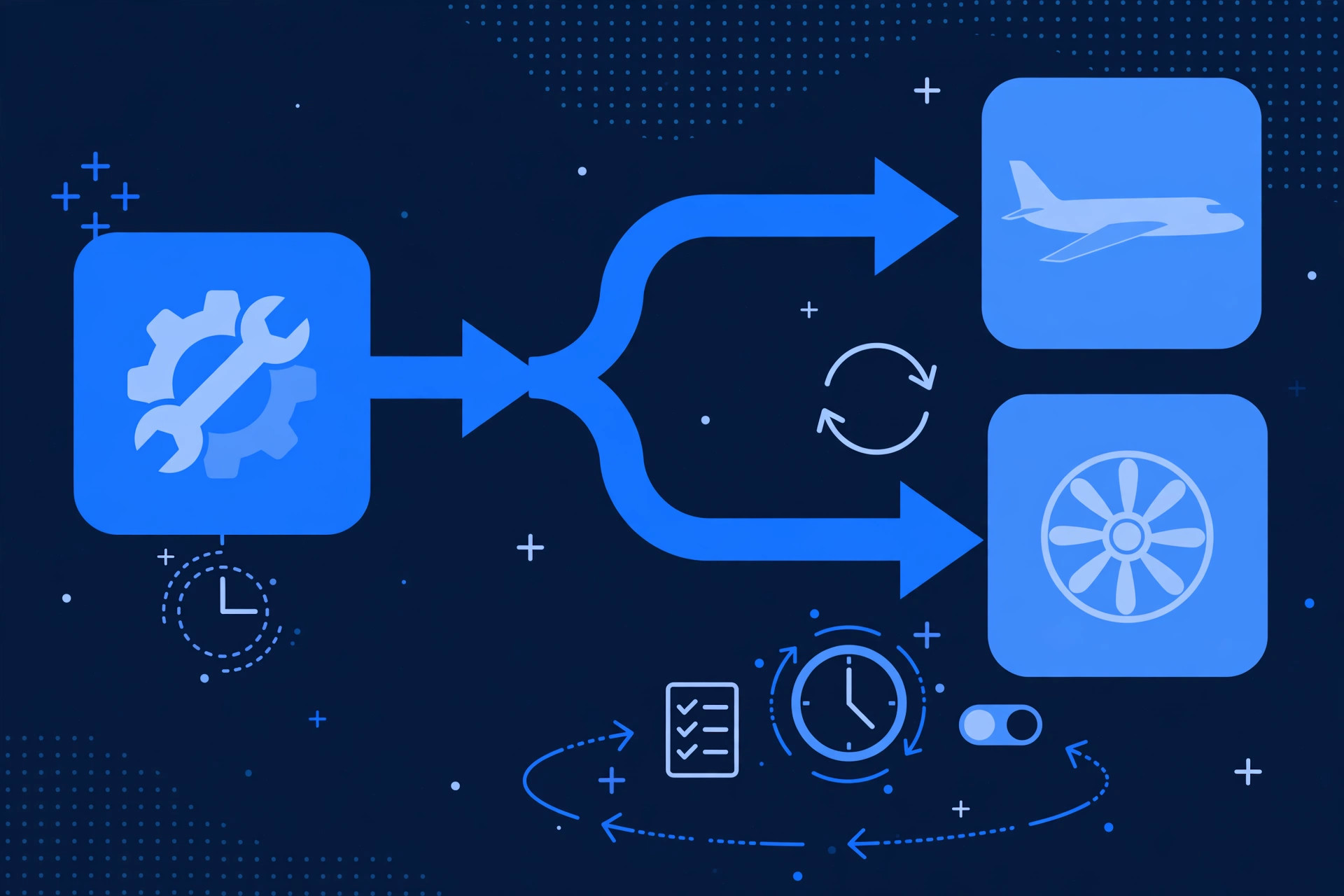
If you are sorting out amg vs ama vs amp, take the AMG (General) first, then the AMA (Airframe) and AMP (Powerplant) in either order. The AMG has 60 questions, the AMA and AMP have 100 each, all three allow 2.0 hours, and each requires 70% to pass (FAA Airman Knowledge Testing Matrix).
What does each test actually cover?
The three codes name three different slices of the same job. The AMG is the shared foundation every mechanic needs. The AMA is everything about the aircraft itself except its engines. The AMP is engines and the systems that support them, including propellers (FAA-G-ACS-1 Companion Guide).
| Test | Full name | Questions | Time | Pass mark | ACS subject areas |
|---|---|---|---|---|---|
| AMG | Aviation Mechanic General | 60 | 2.0 hours | 70% (42 correct) | 12 |
| AMA | Aviation Mechanic Airframe | 100 | 2.0 hours | 70% (70 correct) | 15 |
| AMP | Aviation Mechanic Powerplant | 100 | 2.0 hours | 70% (70 correct) | 13 |
Source: question counts, times, and passing scores per the FAA Airman Knowledge Testing Matrix; subject-area counts per the FAA-G-ACS-1 Companion Guide.
AMG — General. The 12 General areas are Mathematics, Physics, Basic Electricity, Aircraft Drawings, Weight and Balance, Fluid Lines and Fittings, Materials and Hardware, Cleaning and Corrosion Control, Inspection Concepts and Techniques, Regulations, Human Factors, and Ground Operations and Servicing (FAA-G-ACS-1 Companion Guide). Nothing here belongs to one rating more than the other, which is exactly why this test sits in front of both of them.
AMA — Airframe. The 15 Airframe areas run from Metallic and Non-Metallic Structures through Flight Controls, Landing Gear, Hydraulic and Pneumatic Systems, Environmental Systems, Instrument Systems, Communication and Navigation Systems, Fuel Systems, Electrical Systems, Ice and Rain Control, Fire Protection, Rotorcraft Fundamentals, and Water and Waste Systems (FAA-G-ACS-1 Companion Guide). It is the broadest of the three tests by subject count.
AMP — Powerplant. The 13 Powerplant areas cover Reciprocating Engines, Turbine Engines, Engine Inspection, Engine Instrument Systems, Engine Fire Protection, Engine Electrical Systems, Lubrication Systems, Ignition and Starting Systems, Engine Fuel and Fuel Metering Systems, Reciprocating Engine Induction and Cooling Systems, Turbine Engine Air Systems, Engine Exhaust and Reverser Systems, and Propellers (FAA-G-ACS-1 Companion Guide). Newcomers are often surprised to find propellers here rather than on the Airframe test. On this test, they are.
Every question on all three tests is objective multiple-choice with a single correct response, and each question is independent of the others (FAA-G-ACS-1 Companion Guide).
Why does General come first?
Because General is required for either rating, and because its material is the vocabulary the other two tests assume. An applicant is not required to repeat the General section of a test for a mechanic rating if it was previously passed, which is the regulatory shape of a shared first step: pass it once, then build the rating or ratings you want on top of it (FAA Order 8610.12).
There is also a school-specific reason General can come early. An applicant may take the mechanic General written test before meeting the experience requirements if they present an authenticated document from a certificated aviation maintenance technician school showing satisfactory completion of the General portion of that school's curriculum (14 CFR 65.75). In practice, that is how most AMTS students meet the AMG: finish the General block, sit for the AMG, then move into Airframe and Powerplant coursework with the first written already banked.
General-first is also the gentlest on-ramp by format. The AMG gives you 120 minutes for 60 questions, which is 2 minutes per question (FAA Airman Knowledge Testing Matrix). The AMA and AMP give you the same 120 minutes for 100 questions, which is 72 seconds per question (FAA Airman Knowledge Testing Matrix). Learning how FAA questions are written, how the testing supplement works, and how your pacing feels, on the slower-paced test first, is simply the cheaper place to learn it.
Do Airframe and Powerplant have to be taken in a set order?
No. After General, the Airframe and Powerplant writtens can be taken in either order, because each one belongs to its own rating. The mechanic certificate's ratings are Airframe and Powerplant, and each rating stands on its own requirements (14 CFR 65.73). Most candidates take them in the order their school teaches them, or in the order their documented experience supports: structures and systems first if that is where your hours are, engines first if engines are your background.
What is not flexible is the finish line. You must pass each section of the written test before applying for the oral and practical tests for that rating (14 CFR 65.75), and all of the prescribed tests must be passed within a period of 24 months (14 CFR 65.71). So the order between AMA and AMP is your choice, but the clock is not: once your first pass starts the sequence, plan the remaining writtens and the oral and practical work so everything lands inside that 24-month window (14 CFR 65.71).
Can you take just one rating?
Yes, and this is where the three-test picture often confuses people. You do not have to earn both ratings. A mechanic certificate can carry an Airframe rating alone or a Powerplant rating alone (14 CFR 65.73).
- Airframe only: AMG (General) plus AMA (Airframe), then the oral and practical tests covering the General and Airframe sections (14 CFR 65.75; 14 CFR 65.79)
- Powerplant only: AMG (General) plus AMP (Powerplant), then the oral and practical tests covering the General and Powerplant sections (14 CFR 65.75; 14 CFR 65.79)
- Both ratings (the full A&P): all three writtens, then the oral and practical tests for both ratings (14 CFR 65.75; 14 CFR 65.79)
The experience requirement scales the same way. Each applicant must present either a graduation certificate from a certificated aviation maintenance technician school or documentary evidence of at least 18 months of practical experience appropriate to the rating sought, or at least 30 months of practical experience concurrently performing duties appropriate to both ratings (14 CFR 65.77). One rating, 18 months or school. Both ratings, 30 months concurrent or school. That is the real fork in the road, and it is worth deciding before you schedule anything, because it changes how much experience you need to document.
If you earn one rating first and add the second later, you do not start over. A certificated mechanic applying for an additional rating must meet the experience requirements and, within a period of 24 months, pass the tests prescribed for the additional rating sought (14 CFR 65.71). The General pass you already hold does not need to be retaken to add a rating.
What do A&P and AMT actually mean?
These two terms cause more confusion than the test codes do, so here is the plain version.
A&P is shorthand for the two ratings together: Airframe and Powerplant. When an employer asks for an "A&P mechanic," they mean a certificated mechanic holding both ratings (14 CFR 65.73). A&P is not a separate test and not a separate certificate. It is the full mechanic certificate with both ratings on it.
AMT is a job title, not a credential: Aviation Maintenance Technician. Schools use it for their programs, and the FAA uses Aviation Maintenance Technician in the names of the tests and schools, but no certificate is issued in that name (FAA Airman Knowledge Testing Matrix). The certificate itself is the mechanic certificate, with the Airframe rating, the Powerplant rating, or both (14 CFR 65.73).
And the three codes follow the same pattern. AMG, AMA, and AMP are test codes for the three knowledge tests (FAA Airman Knowledge Testing Matrix). None of them is a license. Passing all three writtens is one stage; you still complete the oral and practical tests with a Designated Mechanic Examiner before the certificate is issued (14 CFR 65.79).
Which written should you study for first if you are starting from zero?
The AMG, even if engines or structures are what drew you to the field. Three reasons, all practical.
First, it is required no matter which rating or ratings you finish with, so none of the study is wasted (14 CFR 65.75). Second, its calculation and electricity material underpins questions you will meet again in Airframe electrical systems and Powerplant electrical and instrument systems (FAA-G-ACS-1 Companion Guide). Third, at 60 questions it is the shortest test of the three, so it is the fastest honest signal of whether your study method works before you commit to a 100-question test (FAA Airman Knowledge Testing Matrix).
Upward Prep's AMG bank has 600 questions mirroring the ACS subject weights, so your practice split matches the test's own split across its 12 areas. Start there, get the foundation certified, and let the Airframe-versus-Powerplant order be decided by your coursework or your experience, not by habit.
What this article can't do for you
This article can lay out the sequence: General first, then Airframe and Powerplant in either order, each test passed on its own 70% line, everything inside 24 months (FAA Airman Knowledge Testing Matrix; 14 CFR 65.71). It cannot tell you whether you are ready for the first step of that sequence today. You might be solid on regulations and shaky on electricity calculations, and the AMG will find that out in the first 15 questions. No comparison table can measure that for you.
That measurement is what a diagnostic is for. Upward Prep's free 10-question diagnostic mirrors the AMG's ACS subject weights and gives cited explanations for every answer, so you can see which of the 12 General areas would cost you questions before you schedule the real 60-question test. Try the free AMG practice test →
Frequently asked questions
do i take general first
Yes. The General test (AMG) is the shared first step for either rating, and an applicant is not required to repeat the General section for a mechanic rating if it was previously passed (FAA Order 8610.12). AMTS students can take the AMG even before meeting the experience requirements, with an authenticated school document showing completion of the General portion of the curriculum (14 CFR 65.75).
which test first
General first, then Airframe and Powerplant in either order. The AMG has 60 questions, the AMA and AMP have 100 each, all three allow 2.0 hours, and each requires 70% to pass (FAA Airman Knowledge Testing Matrix). Choose the AMA-versus-AMP order by your coursework sequence or by which rating your documented experience supports (14 CFR 65.77).
a&p vs amt
A&P means a mechanic certificate holding both the Airframe and Powerplant ratings (14 CFR 65.73). AMT, Aviation Maintenance Technician, is the job title used by schools and in FAA test and school names; it is not a separate certificate (FAA Airman Knowledge Testing Matrix). The credential is always the mechanic certificate, with one rating or both.
general airframe powerplant knowledge test
Together, the three knowledge tests are 260 scored questions: 60 on General, 100 on Airframe, and 100 on Powerplant, each in 2.0 hours at a 70% passing score (FAA Airman Knowledge Testing Matrix). The questions are drawn from 12 General, 15 Airframe, and 13 Powerplant ACS subject areas (FAA-G-ACS-1 Companion Guide), and every question is multiple-choice with a single correct response (FAA-G-ACS-1 Companion Guide).
amg vs ama vs amp
AMG is General (60 questions, foundation material for both ratings), AMA is Airframe (100 questions, structures and aircraft systems), and AMP is Powerplant (100 questions, engines, engine systems, and propellers) (FAA Airman Knowledge Testing Matrix; FAA-G-ACS-1 Companion Guide). Take AMG first; take AMA and AMP in either order after that.