
What's Actually on the AMP Exam: Subject-by-Subject Breakdown
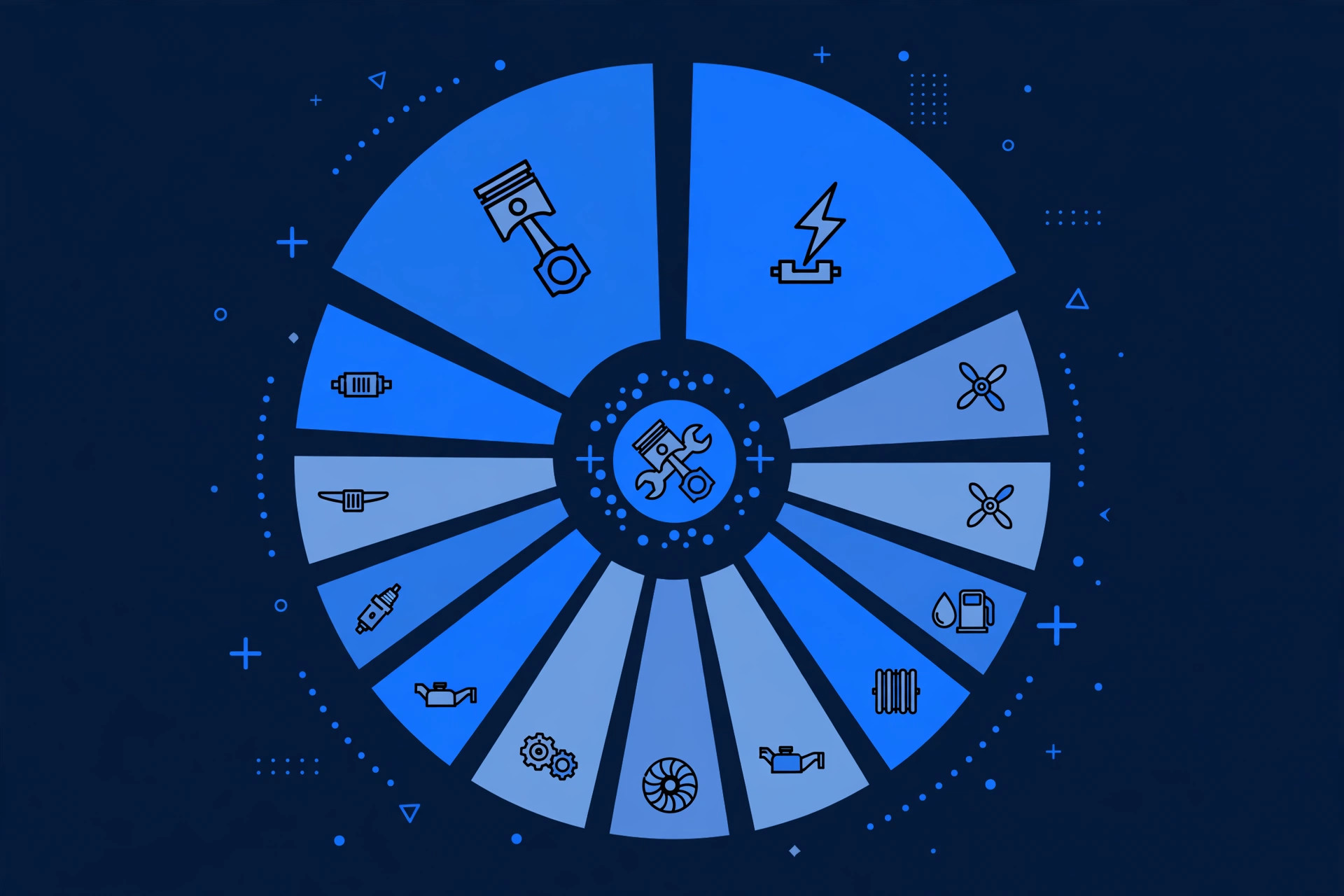
What is on the AMP exam is 100 multiple-choice questions drawn from 13 subject areas in Section III of the FAA Aviation Mechanic Airman Certification Standards: reciprocating engines, turbine engines, engine inspection, instruments, fire protection, electrical, lubrication, ignition and starting, fuel metering, induction and cooling, turbine air, exhaust and reversers, and propellers (FAA Aviation Mechanic ACS, FAA-S-ACS-1, Section III).
Try 3 real AMP questions
Real questions from the AMP bank, with the cited explanation for every answer. Tap an answer to check it.
1. In a radial reciprocating engine, how are the cylinders arranged?
A radial engine has its cylinders arranged radially — in a circle around the central crankcase, like spokes of a wheel. This arrangement aids cooling airflow over all cylinders.
Source: Aviation Maintenance Technician Handbook—Powerplant (FAA-H-8083-32B), Chapter 1, Aircraft Engines — Reciprocating engine types
2. A reciprocating engine develops 200 brake horsepower while consuming 100 pounds of fuel per hour. What is its specific fuel consumption (SFC)?
SFC is the fuel weight in pounds per hour per horsepower: SFC = fuel flow ÷ horsepower = 100 pph ÷ 200 hp = 0.5 lb/hp/hr. Lower SFC means more economical operation.
Source: Aviation Maintenance Technician Handbook—Powerplant (FAA-H-8083-32B), Chapter 1, Aircraft Engines — Horsepower/SFC
3. How is the fuel/air charge ignited in a diesel-cycle aircraft engine?
The diesel cycle depends on high compression pressures to ignite the charge: air is compressed, fuel is sprayed in at maximum pressure, and the resulting heat causes the fuel to burn. No spark plugs are used.
Source: Aviation Maintenance Technician Handbook—Powerplant (FAA-H-8083-32B), Chapter 1, Aircraft Engines — Diesel Cycle
Where does this breakdown come from?
It comes from the FAA's own publications, not from a prep company's guess. The subject areas are the 13 knowledge areas in Section III of the Aviation Mechanic ACS, FAA-S-ACS-1, and the Companion Guide to that standard, FAA-G-ACS-1, publishes both the written test description and the percentage of test questions each area carries (FAA-G-ACS-1 Companion Guide).
The AMP is the Powerplant test, one of the three FAA written tests on the way to an Airframe and Powerplant certificate. AMP on its own is a single knowledge test, not the A&P certificate itself: the certificate takes the applicable writtens plus the oral and practical exams (FAA-G-ACS-1 Companion Guide, Ch. 1). Its full format, next to the other two writtens, is:
| Test | Questions | Time | Pass score |
|---|---|---|---|
| AMG (General) | 60 | 2.0 hours | 70% (42 correct) |
| AMA (Airframe) | 100 | 2.0 hours | 70% (70 correct) |
| AMP (Powerplant) | 100 | 2.0 hours | 70% (70 correct) |
Source: FAA-G-ACS-1 Companion Guide, Ch. 3, Written Test Description table
One more format fact shapes how you should read everything below: the written test is worked with the FAA-CT-8080-4G testing supplement, a booklet of figures and diagrams you reference during the exam (FAA Airman Knowledge Testing Matrix). Some questions point at those figures, so the supplement itself is part of what is on the test.
What are the 13 subject areas at a glance?
Here is the whole test on one table: each ACS knowledge area, in the order Section III lists it, the share of the test the FAA assigns it, and what that share means in questions on a 100-question test.
| Subject area | Share of the test | Questions (of 100) |
|---|---|---|
| Reciprocating Engines | 5–15% | 5–15 |
| Turbine Engines | 5–10% | 5–10 |
| Engine Inspection | 5–10% | 5–10 |
| Engine Instrument Systems | 5–10% | 5–10 |
| Engine Fire Protection Systems | 5–10% | 5–10 |
| Engine Electrical Systems | 5–15% | 5–15 |
| Engine Lubrication Systems | 5–10% | 5–10 |
| Ignition and Starting Systems | 5–10% | 5–10 |
| Engine Fuel and Fuel Metering Systems | 5–10% | 5–10 |
| Reciprocating Engine Induction and Cooling Systems | 5–10% | 5–10 |
| Turbine Engine Air Systems | 5–10% | 5–10 |
| Engine Exhaust and Reverser Systems | 5–10% | 5–10 |
| Propellers | 5–10% | 5–10 |
Sources: subject areas per FAA Aviation Mechanic ACS, FAA-S-ACS-1, Section III; weight bands per the FAA-G-ACS-1 Companion Guide, percentage-of-test-questions table for the AMP 100-question test; question counts are the bands applied to 100 questions.
Two things are worth noticing. First, the bands are ranges, not fixed counts: the FAA builds each test form inside these percentages, so your form's exact split will differ slightly from another candidate's. Second, only two areas sit in the higher band. Reciprocating Engines and Engine Electrical Systems can each supply up to 15 of your 100 questions (FAA-G-ACS-1 Companion Guide, percentage-of-test-questions table). No other single area can cost you that much on its own.
The FAA's official study handbook for this test is the Aviation Maintenance Technician Handbook — Powerplant, FAA-H-8083-32B. Its subjects are aircraft engines, engine fuel and fuel metering systems, induction and exhaust systems, engine ignition and electrical systems, engine starting systems, lubrication and cooling systems, propellers, engine removal and replacement, engine fire protection systems, engine maintenance and operation, and light-sport aircraft engines (FAA-H-8083-32B, subjects covered). The overlap with the 13 ACS areas is close but not exact: two handbook subjects, engine removal and replacement and light-sport aircraft engines, do not appear as ACS areas of their own (FAA Aviation Mechanic ACS, FAA-S-ACS-1, Section III). Treat them as support material, and let the ACS list set your checklist.
The engine cores: reciprocating engines and turbine engines
Every other area on this test exists to support one of these two. They are the engines themselves; the remaining eleven areas are the systems, inspections, and instruments around them.
Reciprocating Engines (5–15%) is one of the two heavyweight areas, tied only with Engine Electrical Systems (FAA-G-ACS-1 Companion Guide, percentage-of-test-questions table). It covers the piston engine itself: how it is built, how it runs, and how it performs, the first subject in the FAA's powerplant handbook (FAA-H-8083-32B, subjects covered). At the top of its band it is 15 of your 100 questions, half of everything you are allowed to miss. Shop familiarity helps here, but it deserves a check rather than an assumption: the formal terms the questions use are not always the shop's terms.
Turbine Engines (5–10%) covers the turbine engine itself, the second core (FAA Aviation Mechanic ACS, FAA-S-ACS-1, Section III). For candidates whose experience is mostly piston work, this is usually the least familiar material on the test. The handbook treats aircraft engines as one subject covering both cores (FAA-H-8083-32B, subjects covered), but the ACS tests them as two separate areas, and a strong reciprocating score does not carry over. Give turbine theory its own early study block.
The systems that keep an engine running: electrical, lubrication, ignition, fuel
Four areas cover the systems every engine, piston or turbine, depends on. Together they can account for a large share of the test: one of them reaches 5–15% and the other three are 5–10% each (FAA-G-ACS-1 Companion Guide, percentage-of-test-questions table).
Engine Electrical Systems (5–15%) is the second heavyweight area (FAA-G-ACS-1 Companion Guide, percentage-of-test-questions table). The handbook covers this material as engine ignition and electrical systems (FAA-H-8083-32B, subjects covered), while the ACS splits the ignition side into its own area below, so plan your reading across both. Like Reciprocating Engines, it rewards learning the system as a connected whole, then drilling it under time.
Engine Lubrication Systems (5–10%) and Ignition and Starting Systems (5–10%) are paired in the handbook as lubrication and cooling systems and as engine starting systems alongside ignition and electrical systems (FAA-H-8083-32B, subjects covered; FAA Aviation Mechanic ACS, FAA-S-ACS-1, Section III). Both are follow-the-flow subjects: what moves through the system, in what order, and what changes when a part of it fails. That structure makes them efficient to study, because one clear pass through the system's path answers several different question angles at once.
Engine Fuel and Fuel Metering Systems (5–10%) covers both the fuel system and how fuel is metered to the engine, one combined ACS area with its own matching handbook subject (FAA Aviation Mechanic ACS, FAA-S-ACS-1, Section III; FAA-H-8083-32B, subjects covered). Do not confuse it with the fuel system areas on the other writtens: this one is about the engine side, getting the right amount of fuel to the engine in the right condition.
Air in, air out: induction, turbine air, exhaust and reversers
Three areas follow the air through the engine, and the ACS splits them by engine type, which tells you how to study them: in sequence, along the path the air actually takes.
Reciprocating Engine Induction and Cooling Systems (5–10%) is the piston side: the air coming in, and the cooling that keeps a reciprocating engine at working temperature (FAA Aviation Mechanic ACS, FAA-S-ACS-1, Section III). The handbook covers the underlying material across its induction and exhaust systems subject and its lubrication and cooling systems subject (FAA-H-8083-32B, subjects covered).
Turbine Engine Air Systems (5–10%) is the turbine counterpart: the air systems inside a turbine engine, tested separately from the turbine core itself (FAA Aviation Mechanic ACS, FAA-S-ACS-1, Section III). Candidates who study Turbine Engines and stop there leave this area uncovered. It is its own 5–10 questions.
Engine Exhaust and Reverser Systems (5–10%) covers what happens at the back of the engine for both engine types, exhaust and thrust reversers in a single area (FAA Aviation Mechanic ACS, FAA-S-ACS-1, Section III). The handbook's induction and exhaust systems subject is the reading that supports it (FAA-H-8083-32B, subjects covered).
Watching, protecting, and the surprise topic: inspection, instruments, fire protection, propellers
Engine Inspection (5–10%) tests how engines are inspected, as its own area (FAA Aviation Mechanic ACS, FAA-S-ACS-1, Section III). The handbook supports it through its engine maintenance and operation subject (FAA-H-8083-32B, subjects covered). Hands-on experience helps here, but the formal standards behind the questions are still worth reading rather than assuming.
Engine Instrument Systems (5–10%) covers the instruments that report what the engine is doing (FAA Aviation Mechanic ACS, FAA-S-ACS-1, Section III). These questions connect back to every other system: an instrument question is often a systems question wearing a gauge.
Engine Fire Protection Systems (5–10%) covers detecting and extinguishing engine fires, with its own matching handbook subject (FAA Aviation Mechanic ACS, FAA-S-ACS-1, Section III; FAA-H-8083-32B, subjects covered). It is a compact, learnable area: a defined set of material, tested at the same weight as most of the test.
Propellers (5–10%) is the surprise topic, and the one most often misfiled. Propellers sit in the Powerplant ACS, Section III, not in Airframe (FAA Aviation Mechanic ACS, FAA-S-ACS-1, Section III). That placement makes sense once you see it: the propeller is driven by the engine, and the handbook gives it its own subject alongside the engine systems (FAA-H-8083-32B, subjects covered). Candidates who assume propellers belong to the Airframe test meet them here unprepared, at 5–10 questions (FAA-G-ACS-1 Companion Guide, percentage-of-test-questions table).
How should you use these weights to study?
Study in proportion, and let the arithmetic set your priorities. You need 70 of 100 correct, so you can miss 30 questions (FAA-G-ACS-1 Companion Guide, Ch. 3). A single weak area at the top of the 5–15% band can account for 15 of those 30 misses by itself. That is why Reciprocating Engines and Engine Electrical Systems get the largest shares of your time, and why no 5–10% area gets zero time: six neglected small areas, at up to 10 questions each, can cost far more than one big one.
Pacing follows the same math, and it is tighter here than on the General test. 120 minutes for 100 questions is 72 seconds per question (FAA-G-ACS-1 Companion Guide, Ch. 3). Recall questions should take less, banking time for systems questions that ask you to trace a failure from cause to indication.
After the test, your Airman Knowledge Test Report lists the ACS codes for the areas you missed, whether you passed or not. Those codes become your restudy list, and if you failed, you may retest after 30 days, or sooner with a signed statement of additional instruction in the subjects you failed (14 CFR 65.19).
What this article can't do for you
This breakdown tells you what the exam contains and how it is weighted. It cannot tell you where you stand inside it. Two candidates can both read that Engine Electrical Systems is up to 15% of the test (FAA-G-ACS-1 Companion Guide, percentage-of-test-questions table) and be in opposite positions: one solid on electrical work and weak on turbine air systems, the other the reverse. Reading the weights does not reveal your own pattern of misses, and guessing at it wastes the study time this article just helped you allocate.
That is what a diagnostic is for. Upward Prep's free 25-question AMP practice test mirrors the ACS subject weights, times you like the real thing, and gives cited explanations for every answer, so you can put your hours into the subject areas that are actually costing you points. Try the free AMP practice test →
Frequently asked questions
what is on the powerplant exam
The Powerplant exam, the AMP, is 100 multiple-choice questions drawn from 13 ACS knowledge areas: Reciprocating Engines, Turbine Engines, Engine Inspection, Engine Instrument Systems, Engine Fire Protection Systems, Engine Electrical Systems, Engine Lubrication Systems, Ignition and Starting Systems, Engine Fuel and Fuel Metering Systems, Reciprocating Engine Induction and Cooling Systems, Turbine Engine Air Systems, Engine Exhaust and Reverser Systems, and Propellers (FAA Aviation Mechanic ACS, FAA-S-ACS-1, Section III).
powerplant test topics
The topic list is the 13 areas above, and the FAA's study handbook for them, FAA-H-8083-32B, covers aircraft engines, engine fuel and fuel metering systems, induction and exhaust systems, engine ignition and electrical systems, engine starting systems, lubrication and cooling systems, propellers, engine removal and replacement, engine fire protection systems, engine maintenance and operation, and light-sport aircraft engines (FAA-H-8083-32B, subjects covered). If a topic you are studying does not match one of the 13 areas or the handbook's supporting subjects, it is probably material for the General or Airframe test instead.
engine systems on the amp
Most of the 13 areas are engine systems: Engine Electrical Systems, Engine Lubrication Systems, Ignition and Starting Systems, Engine Fuel and Fuel Metering Systems, Reciprocating Engine Induction and Cooling Systems, Turbine Engine Air Systems, Engine Exhaust and Reverser Systems, Engine Instrument Systems, and Engine Fire Protection Systems (FAA Aviation Mechanic ACS, FAA-S-ACS-1, Section III). The rest are the two engine cores, Reciprocating Engines and Turbine Engines, plus Engine Inspection and Propellers (FAA Aviation Mechanic ACS, FAA-S-ACS-1, Section III).
amp test breakdown
Two areas carry 5–15% of the test each: Reciprocating Engines and Engine Electrical Systems. The other eleven areas carry 5–10% each (FAA-G-ACS-1 Companion Guide, percentage-of-test-questions table). On 100 questions, that works out to 5–15 questions from each heavy area and 5–10 from each of the rest.
how many questions
There are 100 questions on the AMP, with a 2.0-hour time limit and a 70% passing score, which means 70 correct answers and 72 seconds per question (FAA-G-ACS-1 Companion Guide, Ch. 3). The General test that comes before it is shorter, at 60 questions with the same 2.0-hour limit and 70% bar, and the Airframe test matches the AMP at 100 questions (FAA-G-ACS-1 Companion Guide, Ch. 3).