
Dialysis Water Treatment for the CCHT Exam: AAMI Standards Made Simple
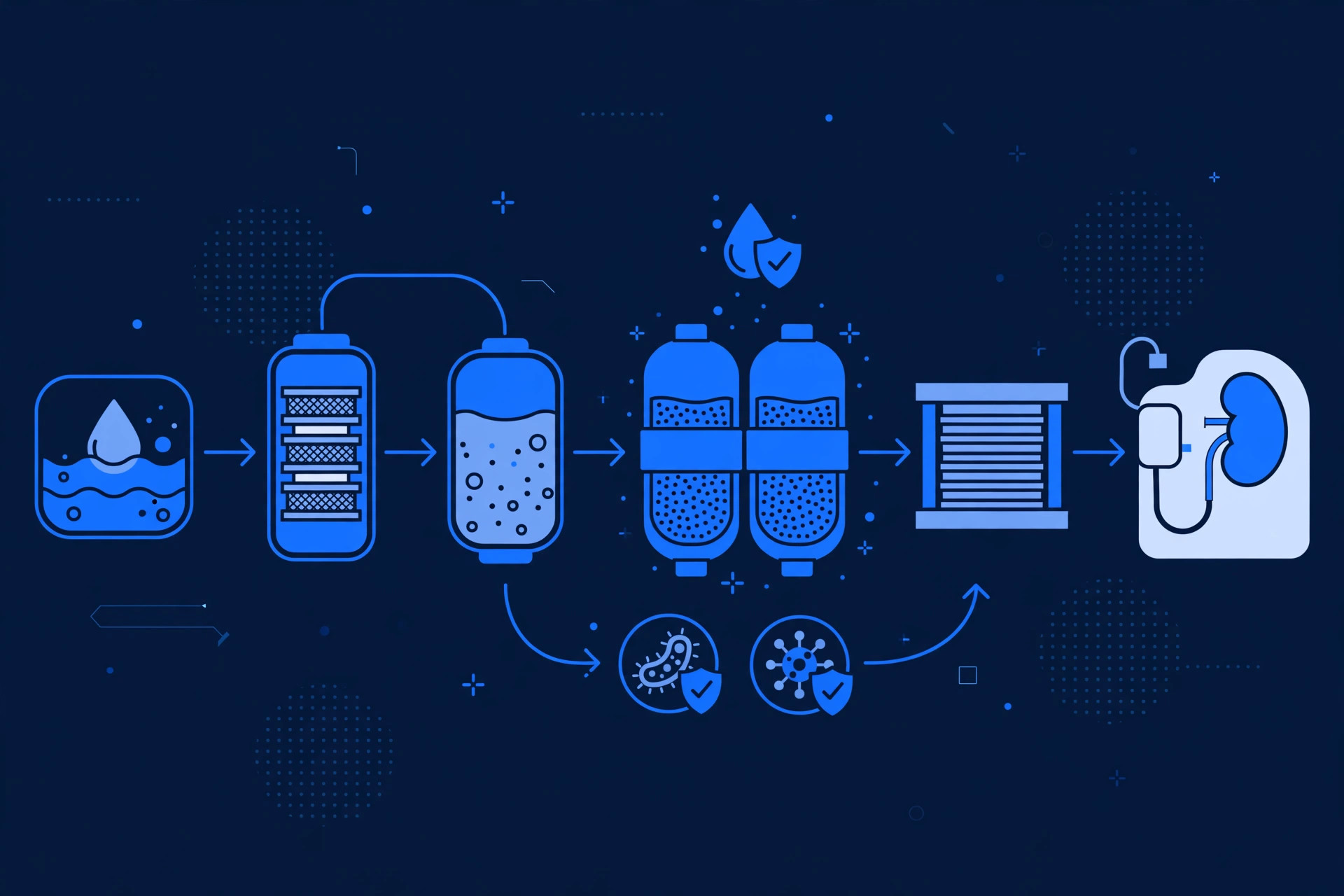
Dialysis water treatment is the multi-stage purification — sediment filtration, softening, carbon adsorption, and reverse osmosis — that makes municipal water safe to mix into dialysate. It matters because a patient can be exposed to 300–600 liters of water during an average week of hemodialysis (CDC).
Why is drinking water not safe enough for dialysis?
Because of volume and route. A patient can be exposed to 300–600 liters of water during an average week of hemodialysis, and the CDC notes that adverse outcomes, including outbreaks, have resulted from dialysate formulated with water containing high levels of chemical or biological contaminants (CDC). Drinking water is ingested in far smaller amounts and passes through the gut first; dialysate sits across a membrane from the patient's blood for hours.
The USP monograph makes the same point from the chemistry side: components found in drinking water that meets EPA regulations can still produce significant negative effects in hemodialysis patients, so the water must be treated further (USP, Water for Hemodialysis Applications). That gap — safe to drink, not safe to dialyze with — is the premise underneath almost every exam question on this topic.
What standard governs dialysis water treatment?
Two layers, and the exam expects you to keep them straight.
The regulatory floor. Federal regulation at 42 CFR § 494.40 requires that water and equipment used for dialysis meet the standards in the AAMI publication "Dialysate for hemodialysis," ANSI/AAMI RD52:2004, which CMS incorporates by reference (42 CFR § 494.40). The same section requires a corrective action plan whenever water testing results — chemical, microbial, or endotoxin — meet AAMI action levels or deviate from the AAMI standards (42 CFR § 494.40).
The preferred, tighter standard. The CDC compares the older regulatory document with the newer ANSI/AAMI/ISO 13959:2014 recommendation side by side (CDC, Water Use in Dialysis):
| Measure | AAMI RD52:2004 (minimum regulatory requirement) | ANSI/AAMI/ISO 13959:2014 (preferred recommendation) |
|---|---|---|
| Bacteria (total viable count) | Below 200 CFU/mL; action level 50 CFU/mL | Below 100 CFU/mL; action level 50 CFU/mL |
| Endotoxin | Below 2 EU/mL; action level 1 EU/mL | Below 0.25 EU/mL; action level 0.125 EU/mL |
Source: CDC, Water Use in Dialysis
Read the table the way a test writer does. The maximum is the line the water must stay under. The action level is lower, and it is not a pass/fail line: it is the point at which the facility must act before the maximum is reached. A bacteria count of 50 CFU/mL under the preferred standard is an action-level result, not a maximum violation — the correct answer is corrective action (CDC; 42 CFR § 494.40).
The chemical limits. The AAMI chemical table reproduced in the USP monograph sets maximum levels for contaminants with documented toxicity in hemodialysis and for the electrolytes normally included in dialysate (USP, Water for Hemodialysis Applications, Table 1):
| Contaminant | Maximum level in dialysis water |
|---|---|
| Aluminum | 0.01 mg/L |
| Chloramines | 0.1 mg/L |
| Free chlorine | 0.5 mg/L |
| Copper | 0.1 mg/L |
| Fluoride | 0.2 mg/L |
| Lead | 0.005 mg/L |
| Nitrate (as N) | 2 mg/L |
| Sulfate | 100 mg/L |
| Zinc | 0.1 mg/L |
| Calcium | 2 mg/L |
| Magnesium | 4 mg/L |
| Potassium | 8 mg/L |
| Sodium | 70 mg/L |
Source: USP, Water for Hemodialysis Applications, Table 1 (reprinted from ANSI/AAMI RD62:2006)
You do not need all thirteen numbers cold — you need the pattern (dialysis limits sit far below drinking-water levels) plus aluminum, chloramine, and free chlorine. KDOQI directs that dialysate aluminum be maintained below 10 µg/L (the same 0.01 mg/L) to prevent aluminum toxicity (NKF KDOQI Guidelines, Guideline 12).
What does each stage of the water treatment train do?
No single device produces dialysis water. The stages run in series; each one removes a class of contaminant or protects the next stage. CMS describes the two purification methods this way: deionization uses filtration and ion exchange, and reverse osmosis uses pressure to force water through a porous membrane (CMS). The working order the exam assumes is:
| Stage | What it does | What goes wrong without it |
|---|---|---|
| Sediment pre-filtration | Traps particulate matter before the sensitive stages | Debris reaches and damages downstream components |
| Water softener | Removes calcium and magnesium hardness before the RO unit; CMS covers a softener specifically when it pretreats water entering an RO unit (CMS) | Hardness damages the RO system — a softener may be installed because calcium and magnesium could damage the RO (DaVita) |
| Carbon tanks | Remove chlorine and chloramine; the federal rule requires a carbon component plus a backup in series (42 CFR § 494.40) | Chloramine reaches the dialysate — see the next section |
| Reverse osmosis (RO) | Pressure forces water through a semipermeable membrane; the purified product water goes to the dialysis machine and the reject water carrying the removed contaminants goes to drain (DaVita) | Dissolved contaminants, bacteria, and endotoxin pass into the product water |
| Deionization (DI), where used | Polishes water by ion exchange; CMS describes DI as removing mineral salts of magnesium and calcium, plus fluoride and chloride compounds, by filtration and ion exchange (CMS) | Ionic purity falls — but note the trap below |
Two traps hide in that table, and both are exam favorites:
- DI does not remove bacteria. The CDC states it directly: a deionization unit does not remove or destroy bacteria, so if DI is the main treatment rather than RO, a submicron or endotoxin/ultrafilter must sit downstream of the DI unit — while RO itself will protect product water from microbial contamination (CDC, Water Use in Dialysis). The same CDC guidance pairs DI use with close monitoring of the resistivity of the product water to detect any decrease in quality (CDC, Water Use in Dialysis).
- Carbon, not RO, is the chloramine barrier. Chloramines are not removed by reverse osmosis or deionization and must be adsorbed by granular activated carbon or neutralized chemically (Ward, 1996, via Mendeley). That is why the carbon stage sits before the RO membrane and why its failure cannot be rescued downstream.
After purification, the distribution system still has to stay clean: the CDC recommends disinfecting water distribution systems on a regular schedule, with monthly disinfection recommended, and performing bacteriologic assays of water and dialysis fluids at least once a month (CDC, Water Use in Dialysis).
Why are there two carbon tanks?
Because chloramine breakthrough is the failure this system cannot afford, and a single tank gives no warning. The federal rule therefore requires a carbon tank plus a backup component or second carbon tank in series (42 CFR § 494.40). CMS guidance describes the same design as a redundant carbon system — primary and secondary tanks with a sample port between them — meeting a requirement of 10 minutes of empty bed contact time (EBCT) (CMS, S&C Letter 15-44).
The sample port between the tanks is the point of the design. Testing follows the sequence written into 42 CFR § 494.40 (42 CFR § 494.40):
- Test after the first (worker) tank. If results from the port after the initial carbon tank are greater than 0.5 mg/L for free chlorine or 0.1 mg/L for chloramines, or equal to or greater than 0.1 mg/L of total chlorine, the second carbon tank must then be tested (42 CFR § 494.40). A high result here means the first tank is exhausted — the second tank is still protecting the patient, and the first tank gets replaced.
- If the last tank also fails, stop and act. If results after the last carbon tank exceed those same parameters, the facility must immediately take corrective action and confirm it worked through testing, or terminate dialysis treatment to protect patients from chlorine/chloramine exposure — and immediately notify the medical director (42 CFR § 494.40).
The FDA's chloramine safety alert shows why: at one large facility, patients experienced hemolysis after chloramine contamination of dialysate water, when increased RO capacity without matching carbon filtration exhausted the charcoal filter and chloramine rose above the AAMI standard of 0.1 ppm (FDA Safety Alert, Chloramine Contamination of Hemodialysis Water Supplies). The same alert includes testing water for chloramines as it exits the first filter at least once per patient shift (FDA Safety Alert). Worker tank, sample port, polisher tank, per-shift testing: that chain is one exam topic, not four.
What numbers does the CCHT exam expect you to know?
Drill these as one set:
| Number | What it is | Source |
|---|---|---|
| 0.1 mg/L | Chloramine maximum; also the total chlorine level at or above which the second carbon tank must be tested | 42 CFR § 494.40; USP Table 1 |
| 0.5 mg/L | Free chlorine maximum | USP Table 1 |
| 0.01 mg/L | Aluminum maximum | USP Table 1 |
| Below 100 CFU/mL; action at 50 | Bacteria in water, preferred ANSI/AAMI/ISO 13959:2014 standard (regulatory RD52:2004 floor: below 200 CFU/mL) | CDC |
| Below 0.25 EU/mL; action at 0.125 | Endotoxin in water, preferred standard (RD52:2004 floor: below 2 EU/mL) | CDC |
| 10 minutes EBCT | Minimum empty bed contact time across the redundant carbon system | CMS, S&C Letter 15-44 |
| Monthly | Bacteriologic assays of water and dialysis fluids; recommended disinfection of the distribution system | CDC |
| At least once per patient shift | Chloramine testing of water exiting the first carbon filter | FDA Safety Alert |
How does the CCHT exam test water treatment?
Water treatment lives in the Technical domain — 32–38 of the 150 questions, covering the extracorporeal circuit, water treatment principles, and machine-related problems, including monitoring the water treatment (Mometrix Academy). Most questions arrive as application-level scenarios, not definitions. Expect these shapes:
- Breakthrough sequencing. A total chlorine result comes back high at the sample port between the carbon tanks. The correct action is to test after the second tank and replace the exhausted first tank — not to stop all treatments, and not to ignore it because the patient water is still protected (42 CFR § 494.40).
- Last-tank failure. The same contaminant is now high after the final carbon tank. The answer changes completely: immediate corrective action confirmed by retesting, or terminate treatment, and notify the medical director (42 CFR § 494.40). Stems that differ only in where the sample was drawn are testing whether you know the two answers are different.
- Wrong-barrier traps. A stem asks what protects the patient from chloramine and offers reverse osmosis as the attractive wrong answer. Chloramines are not removed by RO or DI; granular activated carbon is the barrier (Ward, 1996, via Mendeley).
- DI traps. A stem treats deionization as if it sterilizes water. It does not remove or destroy bacteria, and a DI-based system needs an ultrafilter downstream (CDC, Water Use in Dialysis).
- Maximum-versus-action-level swaps. A result at the action level — bacteria at 50 CFU/mL under the preferred standard — calls for corrective action under a plan, because federal rules require results that meet AAMI action levels to be addressed with a corrective action plan (42 CFR § 494.40; CDC). "No action needed, it is under the maximum" is the distractor.
- Why-it-matters stems. A patient reaction sends you back to the water system: when clinically indicated after adverse reactions, the facility must obtain blood and dialysate cultures and endotoxin levels, evaluate the purification system, and take corrective action (42 CFR § 494.40).
The bottom line
Dialysis water treatment is a chain, and the exam tests it in order: pretreatment protects the membrane, two carbon tanks in series stop chloramine at a 0.1 mg/L limit, reverse osmosis does the main purification, and monthly microbial testing proves the system still works (42 CFR § 494.40; CDC). Learn each stage by what it removes, what it cannot remove, and what you do when its test result changes.
Reading the chain cannot tell you whether you can work through a breakthrough scenario you have never seen, in the right order, under exam timing — the one thing this article cannot do for you. Upward Prep's free 10-question CCHT diagnostic shows you where you stand by domain, with cited explanations for every answer: Try the free CCHT practice test →
Frequently asked questions
dialysis water treatment
Dialysis water treatment is the series of purification stages — pre-filtration, softening, carbon adsorption, reverse osmosis, and, where used, deionization — that brings municipal water within AAMI limits before it is mixed into dialysate. It exists because a patient can be exposed to 300–600 liters of water in an average week of hemodialysis (CDC).
aami water standards
AAMI standards set the allowable and action levels for chemical contaminants, bacterial counts, and endotoxins in dialysis water (CDC, Water Use in Dialysis). Federal regulation incorporates ANSI/AAMI RD52:2004 by reference (42 CFR § 494.40); the CDC lists the tighter ANSI/AAMI/ISO 13959:2014 values — bacteria below 100 CFU/mL, endotoxin below 0.25 EU/mL — as the preferred recommendation (CDC).
what removes chloramine from dialysis water
Carbon. The federal rule requires a carbon tank that removes chlorine/chloramine plus a second carbon tank in series as backup (42 CFR § 494.40), because chloramines are not removed by reverse osmosis or deionization and must be adsorbed by granular activated carbon or neutralized chemically (Ward, 1996, via Mendeley).
how often is dialysis water tested for chlorine
Test the water exiting the first carbon filter for chloramines at least once per patient shift (FDA Safety Alert). If that result is greater than 0.1 mg/L for chloramines, or total chlorine is 0.1 mg/L or more, the water after the second carbon tank must be tested next (42 CFR § 494.40).
what is the aami limit for bacteria in dialysis water
Under the preferred ANSI/AAMI/ISO 13959:2014 standard, below 100 CFU/mL, with an action level of 50 CFU/mL; the older RD52:2004 regulatory minimum is below 200 CFU/mL with the same 50 CFU/mL action level (CDC, Water Use in Dialysis). Bacteriologic assays of water and dialysis fluids are performed at least once a month (CDC, Water Use in Dialysis).
what happens if chloramine is in dialysis water
Patients can be harmed: in the incident behind the FDA's safety alert, patients experienced hemolysis after chloramine contamination of the water used to prepare dialysate, when an exhausted charcoal filter let chloramine rise above the AAMI standard of 0.1 ppm (FDA Safety Alert). If testing after the last carbon tank exceeds the federal parameters, the facility must take immediate corrective action confirmed by testing, or terminate dialysis treatment, and notify the medical director (42 CFR § 494.40).