
Cosmetology vs Esthetician License: Which Should You Get?
Cosmetology vs esthetician is a choice between breadth and depth: a cosmetology license covers hair, skin, and nails, while an esthetician license covers skin only, in less training time and with a narrower, science-heavy exam (NIC Cosmetology Theory CIB; NIC Esthetics Theory CIB). Choose cosmetology for options, esthetics for skin specialization.
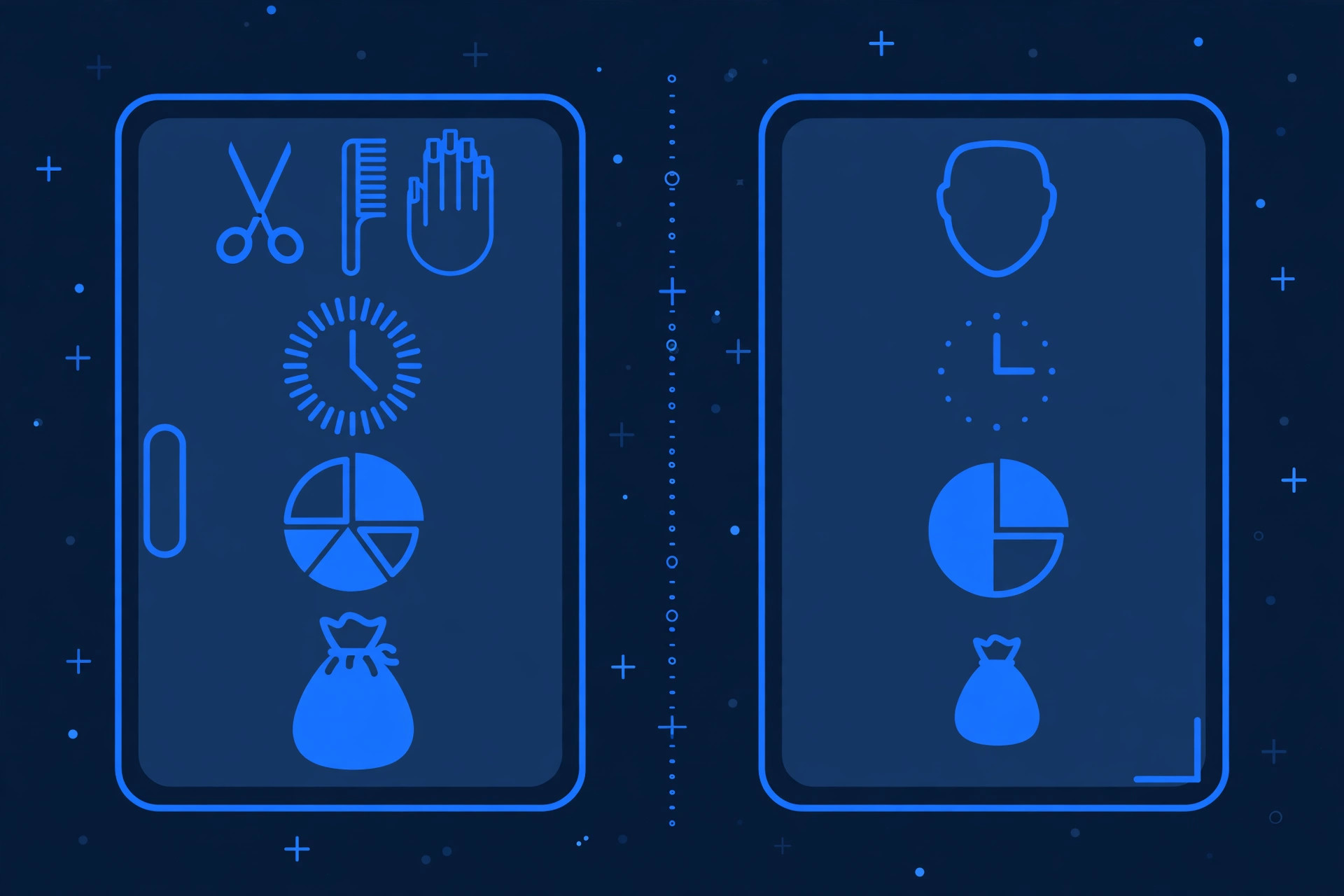
Cosmetology vs esthetician: side by side
| Cosmetology license | Esthetician license | |
|---|---|---|
| Legal scope | Hair, skin, and nails | Skin only |
| Main work | Cutting, coloring, styling and chemical hair services, plus basic facials and nails | Facials, skin analysis, hair removal, makeup, and other skin treatments |
| Training hours (California example) | 1,000 hours | 600 hours |
| NIC theory exam | 110 items (100 scored), 90 minutes | 110 items (100 scored), 90 minutes |
| Exam domains | Scientific Concepts 35%, Hair Care and Services 45%, Skin Care and Services 10%, Nail Care and Services 10% | Scientific Concepts 55%, Skin Care and Services 45% |
| BLS occupation | Hairdressers, hairstylists, and cosmetologists | Skincare specialists |
| 2025 median pay (BLS) | $17.21 per hour for hairdressers, hairstylists, and cosmetologists | $45,330 per year ($21.79 per hour) |
| Jobs, 2025 (BLS) | 595,000 hairdressers, hairstylists, and cosmetologists | 104,200 skincare specialists |
| Projected growth, 2025–35 (BLS) | 7% for barbers, hairstylists, and cosmetologists overall | 9% |
| Typical settings | Salons and full-service salons | Salons, spas, and offices of physicians |
(Sources: NIC Cosmetology Theory CIB; NIC Esthetics Theory CIB; California Board of Barbering and Cosmetology — Exam Quick Tips; BLS — Skincare Specialists; BLS — Barbers, Hairstylists, and Cosmetologists. Hours, fees, and passing scores are set by your state board — the hours row is California's requirement, not a national rule.)
Read the table from the top. The first two rows decide most cases.
What can each license legally do?
A cosmetologist is licensed across hair, skin, and nails. BLS describes hairstylists and cosmetologists as offering a wide range of hair services such as shampooing, cutting, coloring, and styling, and also providing facial and scalp treatments, makeup analysis, and skincare and nail services (BLS — Barbers, Hairstylists, and Cosmetologists). The NIC Cosmetology Theory outline matches that breadth: client consultation, tools, hair care, hair design, and chemical services sit inside Hair Care and Services, with separate, smaller sections for skin care and nail care (NIC Cosmetology Theory CIB).
An esthetician is licensed for skin. BLS, which calls the occupation skincare specialists, says they provide cleansing and other face and body treatments to enhance a person's appearance, give facials, full-body treatments, and head and neck massages, and may provide eyelash services, makeup application, and hair removal (BLS — Skincare Specialists). Their typical duties include evaluating a client's skin condition, discussing treatments, removing unwanted hair using wax or other approved treatments, and recommending skincare products (BLS — Skincare Specialists). An esthetician license does not cover cutting, coloring, or chemically treating hair, and it does not cover nail services.
That overlap is one-way. A cosmetology license already includes basic skin services in most states, so you do not need a second license to offer a basic facial. An esthetician license alone cannot add hair or nail services without the broader program. Confirm the exact lines with your state board before you enroll.
Which training takes longer?
Cosmetology, in every state — because it covers more. Hours are set by the state, not by NIC or by the school, so there is no single national number to quote honestly.
California makes the gap concrete: to qualify for a licensing exam there, you complete a course in a Board-approved school of 1,000 hours for a cosmetologist and 600 hours for an esthetician (California Board of Barbering and Cosmetology — Exam Quick Tips). The state's course rules state the same figures — a cosmetology course of not less than 1,000 hours, and a skin care course of not less than 600 hours (California Board of Barbering and Cosmetology — License Requirements).
Do not read California as the country. Other states set higher or lower hours for both licenses. The pattern that holds everywhere is the ratio: the skin-only license is the shorter program, and the broad license costs you more months in school before you earn anything.
How do the two exams compare?
The mechanics are identical, and the content is not. Both examinations were developed by the National-Interstate Council of State Boards of Cosmetology (NIC), both allow 90 minutes, and both contain 110 items, of which 100 items are weighted and contribute to the candidate's final score (NIC Cosmetology Theory CIB; NIC Esthetics Theory CIB). In both, each sample question is followed by four answer options, with only one correct option (NIC Cosmetology Theory CIB; NIC Esthetics Theory CIB).
Inside that same shell, the blueprints point in opposite directions. Cosmetology spreads its 100 scored questions across Scientific Concepts (35%), Hair Care and Services (45%), Skin Care and Services (10%), and Nail Care and Services (10%) (NIC Cosmetology Theory CIB). Esthetics concentrates its 100 scored questions in just two domains: Scientific Concepts (55%) and Skin Care and Services (45%) (NIC Esthetics Theory CIB).
In plain terms: a cosmetology candidate can be weak on skin and still pass, because skin is a tenth of the test. An esthetics candidate cannot be weak on science and pass, because Scientific Concepts — microbiology, infection control, anatomy, skin histology, and basic chemistry including pH — is more than half of that exam (NIC Esthetics Theory CIB). Neither CIB sets your passing score: your state board does, so check its current bulletin before test day.
Licensure can involve more than theory. BLS notes that skincare specialists take a written and practical exam to get a state license, with requirements varying by state (BLS — Skincare Specialists). A theory practice test prepares you for the written part only.
Which one pays more?
On the BLS medians, the specialist earns more per hour — and the generalist has far more jobs. Skincare specialists earned a 2025 median pay of $45,330 per year ($21.79 per hour), held 104,200 jobs in 2025, and are projected to grow 9 percent from 2025 to 2035, with about 14,200 openings projected each year (BLS — Skincare Specialists). Hairdressers, hairstylists, and cosmetologists earned a median hourly wage of $17.21 in May 2025 and held about 595,000 jobs in 2025, within a combined barbers, hairstylists, and cosmetologists group projected to grow 7 percent from 2025 to 2035, with about 80,300 openings projected each year (BLS — Barbers, Hairstylists, and Cosmetologists).
Range-frame those numbers. The lowest 10 percent of skincare specialists earned less than $14.22 an hour and the highest 10 percent earned more than $39.45 in May 2025; for hairdressers, hairstylists, and cosmetologists, the lowest 10 percent earned less than $13.00 and the highest 10 percent earned more than $34.23 (BLS — Skincare Specialists; BLS — Barbers, Hairstylists, and Cosmetologists). Setting moves the esthetician median too: $24.81 an hour in offices of physicians, against $21.10 in personal care services (BLS — Skincare Specialists).
These are occupation medians, not starting pay and not a promise — your city, setting, hours, and book of clients will move your pay well above or below them. Part-time work is common for skincare specialists, with schedules that may include evenings and weekends (BLS — Skincare Specialists). Pay alone should not pick your license.
Which jobs does each license lead to?
Cosmetologists work mostly in salons; some lease booth space, while others manage salons or open their own shop after gaining experience (BLS — Barbers, Hairstylists, and Cosmetologists). Skincare specialists usually work in salons or spas, and some work in medical offices; in 2025, 52 percent worked in personal care services, 29 percent were self-employed, and 6 percent worked in offices of physicians (BLS — Skincare Specialists).
The caveat schools underplay: because a cosmetologist can legally offer basic skin services, some full-service salons fill skin work that way. Dedicated spas and physician offices hire for depth in skin. If your goal is a spa or medical-office skin role, ask employers in your area which license they hire for that chair before you choose a program.
So which should you get?
Choose cosmetology if you want hair in your day — cutting, coloring, styling, or chemical services — or you are not yet sure which service you will love. You pay for that flexibility with a longer program, and your skin and nail training will be introductory: 10 scored questions each on the theory exam tells you exactly how introductory (NIC Cosmetology Theory CIB). You can deepen skin skills later with continuing education and product training, but your license, not a short course, is what lets you offer hair at all.
Choose esthetics if you already know skin is the work: facials, skin analysis, hair removal, and helping a client through a treatment plan over repeat visits. You will finish sooner — 600 hours against 1,000 in the California example (California Board of Barbering and Cosmetology — Exam Quick Tips) — start earning sooner, and study one subject deeply instead of three broadly. You give up hair and nails entirely, and there is no small add-on that restores them later; adding them means the broader program.
Do not choose either license only because it is shorter or pays a higher median. The BLS gap is between two occupations doing different work all day (BLS — Skincare Specialists; BLS — Barbers, Hairstylists, and Cosmetologists). Pick the service menu you want to perform, then let hours, exam, and pay order your options inside that choice. If you are still torn, shadow a salon day and a spa day, and read both exam outlines in full — the exam you would rather study for is a useful clue about the job you would rather do.
What this article can't do for you
This comparison can lay out scope, hours, exams, and pay. It cannot tell you how ready you are for the theory exam behind the license you pick. Cosmetology buries its risk in chemical services inside the 45 percent hair domain (NIC Cosmetology Theory CIB). Esthetics buries its risk in science, at 55 percent (NIC Esthetics Theory CIB).
That is what a diagnostic is for. If cosmetology is your path, Upward Prep's free 10-question cosmetology practice test is weighted to the same 35/45/10/10 blueprint, with cited explanations for every answer, backed by a 1,000-question bank, so you can see where you stand. If esthetics is your path, test against its 55/45 blueprint instead.
Take the free 10-question cosmetology practice test →
Frequently asked questions
cosmetology vs esthetician
Cosmetology vs esthetician is breadth against depth: cosmetology covers hair, skin, and nails under one license, while esthetics covers skin only (NIC Cosmetology Theory CIB; NIC Esthetics Theory CIB). In California, the training courses are 1,000 hours for cosmetology and 600 hours for esthetics (California Board of Barbering and Cosmetology — Exam Quick Tips).
can a cosmetologist do esthetician work
Yes, for basic skin services, in most states — hairstylists and cosmetologists also provide facial and scalp treatments and skincare services, alongside their hair work (BLS — Barbers, Hairstylists, and Cosmetologists). What a cosmetology license does not give you is an esthetician's depth: skin is only 10 percent of the cosmetology theory exam, against the whole of the esthetics exam (NIC Cosmetology Theory CIB; NIC Esthetics Theory CIB). Check your state board for your exact scope.
can an esthetician do hair
No. Skincare specialists provide cleansing and other face and body treatments, facials, hair removal, and makeup-related services — not hair cutting, coloring, or chemical hair services (BLS — Skincare Specialists). To offer hair services, you need the cosmetology license, whose theory exam weights Hair Care and Services at 45 percent (NIC Cosmetology Theory CIB).
do estheticians make more than cosmetologists
At the BLS median, yes: skincare specialists earned $45,330 per year ($21.79 per hour) in May 2025, while hairdressers, hairstylists, and cosmetologists earned a median hourly wage of $17.21 in May 2025 (BLS — Skincare Specialists; BLS — Barbers, Hairstylists, and Cosmetologists). Both ranges are wide — the top 10 percent of skincare specialists earned more than $39.45 an hour, and the top 10 percent of hairdressers, hairstylists, and cosmetologists earned more than $34.23 an hour (BLS — Skincare Specialists; BLS — Barbers, Hairstylists, and Cosmetologists).
how long is cosmetology school vs esthetician school
It depends on your state, because hours are state-set. In California, a Board-approved cosmetologist course is 1,000 hours and an esthetician course is 600 hours (California Board of Barbering and Cosmetology — Exam Quick Tips). Your own state's figures will differ, so confirm them with your state board before you compare program lengths or prices.
which is better cosmetology or esthetician
Neither, in general — they license different work. Cosmetology is better if you want hair, skin, and nails and the widest service menu (NIC Cosmetology Theory CIB). Esthetics is better if you want skin only, a shorter program in the state examples above, and deeper training in facials, skin analysis, and hair removal (NIC Esthetics Theory CIB; California Board of Barbering and Cosmetology — Exam Quick Tips). Choose by the services you want to perform every day, not by the median pay alone.