
How Many Questions Are on the CPT Exam?
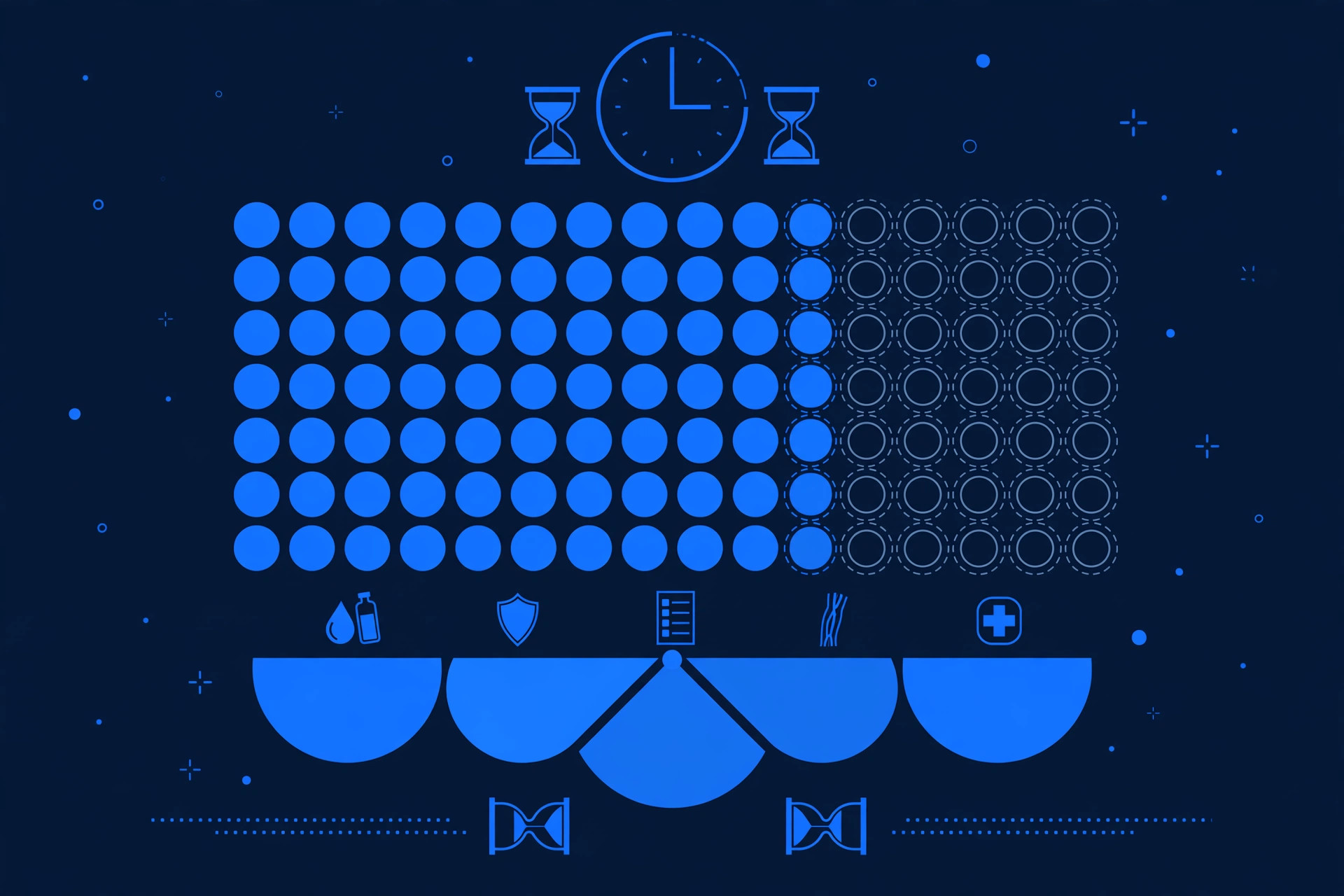
If you are asking how many questions are on the CPT exam, the answer is 120 questions in 2 hours: 100 scored questions count toward your result, and 20 unscored pretest questions do not, and you cannot tell which is which while you test (NHA CPT Test Plan).
Try 3 real CPT questions
Real questions from the CPT bank, with the cited explanation for every answer. Tap an answer to check it.
1. An ammonia level is drawn. The phlebotomist should:
Ammonia is highly unstable — red cells generate it continuously at room temperature, so the specimen must go on ice immediately and reach the lab STAT (ideally analyzed within 30 minutes). Room-temperature delays falsely elevate ammonia; warming accelerates generation; next-day mailing renders the result meaningless.
Source: CLSI GP41 — ammonia handling; Phlebotomy Essentials, 7th ed. (McCall & Tankersley) — special collections; NHA CPT Test Plan, Domain 4 (Special Collections)
2. An order requires only a light blue top and an SST. Which is drawn first?
Citrate (light blue) precedes all serum tubes including SST in the CLSI order, because SST tubes contain clot activator and gel whose carryover could affect the coagulation specimen. 'Serum before heparin' does not mean serum before citrate — citrate's position is second only to blood cultures. This is a classic exam trap.
Source: CLSI GP41 — order of draw; Phlebotomy Essentials, 7th ed. (McCall & Tankersley), Ch. 8 — Venipuncture; NHA CPT Test Plan, Domain 3 (Routine Blood Collections)
3. A premature neonate in the NICU needs a heelstick for a bilirubin level. Which lancet choice best protects this patient?
In premature and low-birth-weight neonates the distance from skin to calcaneus can be well under 2.0 mm, so the shallower 1.0-mm dermal puncture devices are preferred to eliminate the risk of striking bone. Depth must never exceed 2.0 mm in any patient, and firm pressure or milking of the site must be avoided because it hemolyzes the specimen and dilutes it with tissue fluid.
Source: Phlebotomy Essentials, 7th ed., Ch. 9 (Dermal Puncture); CLSI H04-A6
What do the three numbers — 120, 100, and 20 — actually mean?
The test plan states the format in its heading: 100 scored items and 20 pretest items, with an exam time of 2 hours (NHA CPT Test Plan). Scored means the question counts. Your result is built only from how you answer those 100 questions.
Pretest means tryout. The Candidate Handbook explains that pretest questions are asked to determine the validity of using the question as a scored item on a future exam, that pretest questions do not affect your score, and that only the scored questions count toward your official score (NHA Candidate Handbook). NHA is testing new questions on you at the same time it is testing you.
| Count | What it means | Counts toward your score? |
|---|---|---|
| 120 | Total questions you answer | You answer all of them |
| 100 | Scored questions | Yes — these build your result |
| 20 | Pretest questions | No — tryouts for future exams |
Source: counts and 2-hour time limit from the NHA CPT Test Plan; pretest purpose and scoring treatment from the NHA Candidate Handbook.
The practical rule follows from one handbook sentence: you are not aware which questions are scored questions and which questions are pretest questions (NHA Candidate Handbook). So do not spend time trying to spot the pretest items, and do not coast on a question because it looks odd or unusually hard. An odd-looking question is just as likely to be one of the 100 that count.
All NHA exams are multiple choice exams, administered under proctored testing conditions (NHA Candidate Handbook). For the CPT, you take the two-hour exam at your school, at a PSI testing center, or through live remote proctoring (NHA — Certified Phlebotomy Technician (CPT)). The count and the clock are the same in all three settings.
How are the 100 scored questions divided?
The current test plan is based on a job analysis completed in 2024, and it divides the 100 scored questions across five domains (NHA CPT Test Plan):
| Domain | Scored questions | Share of scored exam |
|---|---|---|
| Routine Blood Collections | 28 | 28% |
| Safety and Compliance | 26 | 26% |
| Patient Preparation | 20 | 20% |
| Processing | 14 | 14% |
| Special Collections | 12 | 12% |
| Total scored | 100 | 100% |
Source: NHA CPT Test Plan.
Two domains carry more than half your score. Routine Blood Collections and Safety and Compliance together are 54 of the 100 scored questions (NHA CPT Test Plan). That split should shape how you study: the order of draw, tube selection, and collection technique inside Routine Blood Collections, and the safety rules inside Safety and Compliance, are worth more combined than the other three domains put together.
The 20 pretest items sit on top of this table, not inside it. They are mixed through the sitting, they carry no domain label you can see, and they do not change the 100-question split above (NHA Candidate Handbook).
How much time do you get per question?
The exam time is 2 hours for all 120 questions (NHA CPT Test Plan). Divide 120 minutes by 120 questions and the budget is 60 seconds per question. That is an average, not a rule for any single item: a short recall question about a tube additive may take you 20 seconds, and a scenario question about a difficult draw may fairly take 90. What you cannot afford is a pattern of long stalls, because the average has no slack built into it.
Plan your sitting in blocks instead of watching one global clock. At the halfway point — 60 minutes in — you want to be at or past question 60. If you are behind at halfway, the fix is pace, not panic: answer the question in front of you, make your best choice, and move. A question you cannot solve in two minutes is costing you a second question somewhere later in the exam.
The clock rules make this stricter than it first sounds. All exams must be completed within a single, continuous session, and you may not stop your exam and return to it later (NHA Candidate Handbook). If you test by live remote proctoring, no breaks are allowed during the session at all (NHA Candidate Handbook). Treat the 2 hours as one unbroken sitting when you rehearse, because that is what test day will be.
Why do some sites say the CPT has 100 questions?
Because 100 is a real number from the same test plan — it is the count of scored items, listed in the test plan heading alongside the 20 pretest items and the 2-hour exam time (NHA CPT Test Plan). A guide that says "100 questions" is usually counting only the questions that affect your score and skipping the pretest items without saying so.
Both answers are describing the same exam. They are counting different things:
- 120 is what you sit for and answer.
- 100 is what your score is built from.
- 20 is what NHA is trying out for future exams while you test.
For planning, use 120. Your pacing, your stamina, and your test-day schedule all have to cover 120 questions in 2 hours (NHA CPT Test Plan). For understanding your score, use 100. And if a source gives you a total that matches neither number, or a time limit other than 2 hours, check it against the current test plan before you trust anything else on the page — the handbook itself points candidates to the test plan for the number of scored questions, the number of pretest questions, and the time allowed (NHA Candidate Handbook).
How many questions do you need to get right to pass?
There is no official fixed number, and any site that gives you an exact one is guessing. NHA scores the exam with a scaled score method: each exam has multiple forms, and the scaled score weights questions by difficulty so that the passing scaled score of 390 is consistent regardless of which form the candidate takes (NHA Candidate Handbook). Scaled scores range from 200 to 500, and you need a scaled passing score of 390 or higher to pass (NHA Candidate Handbook).
That is why the tidy arithmetic misleads. Dividing 390 by 500 gives 78%, but 390 is a point on a converted scale, not a count of correct answers, so "get 78 of the 100 scored questions right" is not an official cutoff. Because the conversion adjusts for your form's difficulty, the raw count behind a 390 moves a little from form to form, and NHA does not publish the conversion.
The honest way to use practice scores is as a margin, not a conversion:
| Your practice accuracy | Correct out of 100 scored-style questions | How to read it |
|---|---|---|
| Around 70% | Around 70 | No margin — a rough day can put you below the line |
| Around 80% | Around 80 | Closer, but still dependent on which domains your misses sit in |
| 85% or better, consistently | 85 or better | A working margin above the passing standard |
Read the table as guidance for your practice targets, not as a promise about your scaled score. Do not study until you can just clear the bar on a good day. Study until clearing it would still happen on a bad one.
The wider context is encouraging, with a catch. In 2024, 57,457 CPT examinations were administered and 75.96% passed (NHA 2024 Annual Pass Rates). Roughly three in four candidates pass. Roughly one in four does not — and with 120 questions decided at about a minute each, the difference is usually preparation and pacing, not a trick in the count.
Your score report will show your score, whether you passed or failed, and diagnostic information on how you performed on each of the major content areas, with each area rated as above, near, or below the passing standard (NHA Candidate Handbook). That per-domain feedback is useful if you pass and want to know your weak spots, and it is essential if you need to retake and rebuild your study plan around the domains that cost you.
How does the real count compare to practice tests?
A practice test can be shorter than the real exam and still be useful, as long as you know what it is measuring. A short diagnostic tells you where you stand by domain. It cannot tell you whether your pace and focus survive question 100, because it never takes you there. Only a full-length, timed run — 120 questions in 2 hours, matching the test plan's format (NHA CPT Test Plan) — rehearses the full sitting.
Use the two tools for the two different jobs:
- Short sets and diagnostics find your weak domains quickly, so your study hours go where the points are.
- Full-length timed runs train the 60-second pace and the stamina the real 120-question sitting demands (NHA CPT Test Plan).
Neither practice number is the exam's number, and that is the point: the diagnostic is a fast sample that shows your readiness by domain, and longer timed runs are how you prove that readiness holds across the whole 2-hour exam.
What this article cannot tell you
This article can tell you exactly what you will sit for: 120 questions, 100 that count, 20 that do not, 2 hours, and a Routine Blood Collections domain worth more than any other (NHA CPT Test Plan). It cannot tell you how those 120 questions will treat you — whether your pace holds at a minute a question, which of the five domains will cost you points, or whether you are ready today or six weeks away.
That is what a diagnostic is for. Upward Prep's free 25-question CPT diagnostic shows you your readiness by domain, with cited explanations for every answer, so you can put your hours into the domains that are actually costing you points before you commit to full-length timed runs. It takes minutes, and it turns this public count into a personal starting point. Try the free CPT practice test →
Frequently asked questions
how many questions are on the cpt exam
There are 120 questions on the CPT exam: 100 scored items plus 20 pretest items, with an exam time of 2 hours (NHA CPT Test Plan). Only the 100 scored questions count toward your official score (NHA Candidate Handbook).
how long is the cpt exam
The CPT exam time is 2 hours for all 120 questions (NHA CPT Test Plan). That works out to an average of 60 seconds per question, so pacing matters from the first question, not just near the end.
how many questions do you need to get right to pass the cpt exam
There is no official exact number. Passing is a scaled score of 390 or higher on a 200–500 scale, and the scaled method weights questions by difficulty so the standard stays consistent across exam forms (NHA Candidate Handbook). NHA does not publish an exact raw-to-scaled conversion, so treat any precise "you can miss exactly this many" figure as an estimate, and aim for a practice margin above the passing level instead.
what score do you need to pass the cpt exam
You need a scaled passing score of 390 or higher, on a scale that ranges from 200 to 500, to pass any examination covered by the Candidate Handbook, including the CPT (NHA Candidate Handbook). The same 390/500 passing standard is the figure NHA lists in its 2024 annual pass-rate report (NHA 2024 Annual Pass Rates).
is the nha cpt exam hard
The format is demanding in specific ways: 120 questions in 2 hours is 60 seconds per question, and 54 of the 100 scored questions sit in just two domains, Routine Blood Collections (28) and Safety and Compliance (26) (NHA CPT Test Plan). In 2024, 57,457 CPT examinations were administered and 75.96% passed (NHA 2024 Annual Pass Rates). The difficulty is less about any single question than about pace and preparation in the two heaviest domains.
what happens if you fail the nha cpt exam
If you do not pass on the first attempt, you may retake the exam after a 30-day waiting period; you are allowed three attempts with a minimum of 30 days between each attempt, and after a third failed attempt you must wait one year before trying again (NHA Candidate Handbook). For each retake you must re-register and pay the full examination price (NHA Candidate Handbook). Your score report rates each major content area as above, near, or below the passing standard — start your retake study with the areas rated below (NHA Candidate Handbook).