
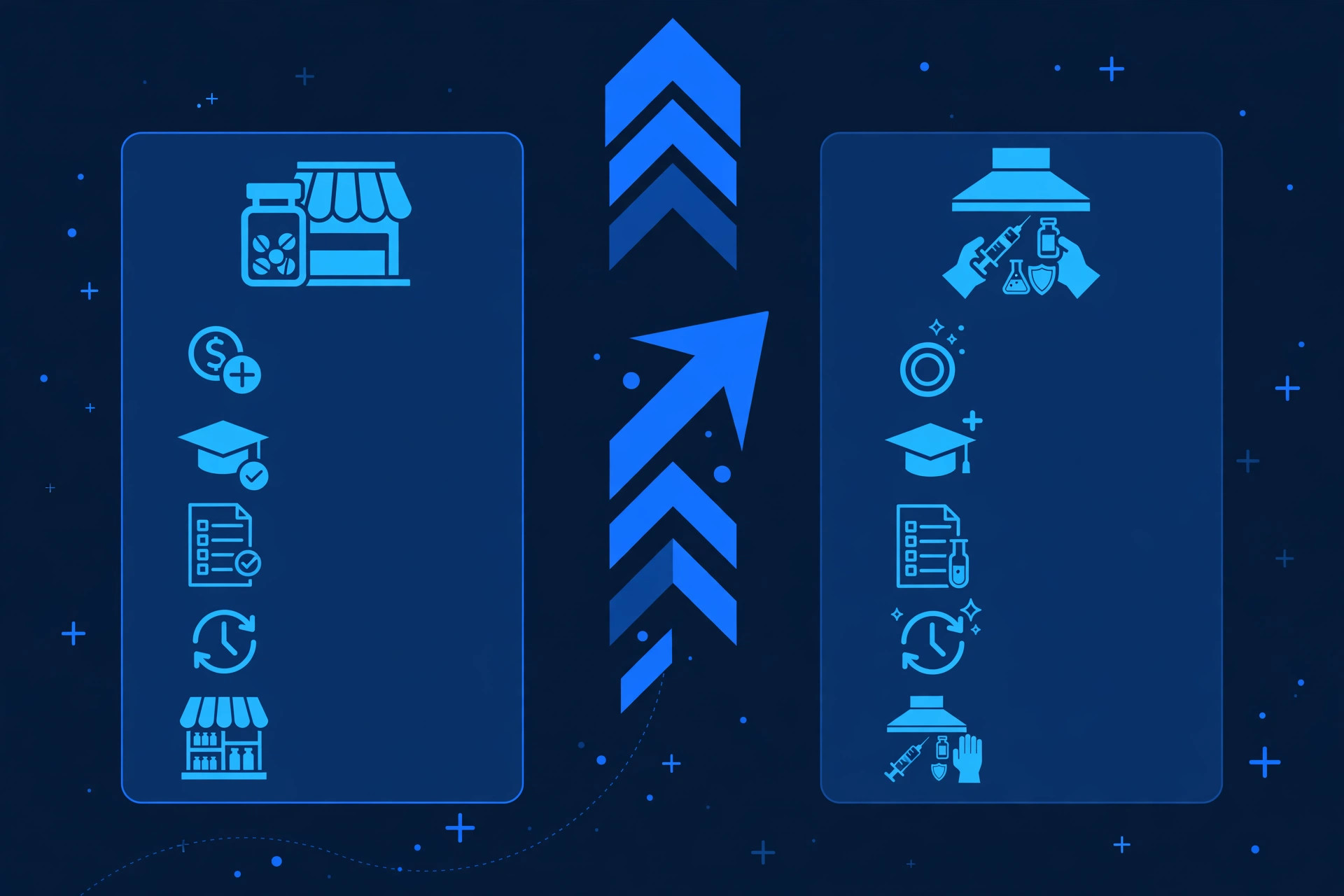
CSPT vs CPhT is not a choice between two entry-level credentials. CPhT comes first: you must hold an active PTCB CPhT before you can sit the CSPT exam. The CSPT is the specialty credential you add on top — a 75-question sterile-compounding exam that costs $199 and opens hospital IV, oncology, and home-infusion roles.
The short version: CPhT first, CSPT second
Think of the two credentials as a sequence, not a fork in the road. The CPhT — Certified Pharmacy Technician — is the entry credential that gets you into pharmacy work. The CSPT — Certified Compounded Sterile Preparation Technician — is PTCB's specialty credential for technicians who compound sterile preparations such as IV medications. It is the pharmacy sterile compounding specialty credential from PTCB, not the surgical "Certified Sterile Processing Technician" credential for people who reprocess surgical instruments — and it is not a starting point: the door opens only once you hold an active PTCB CPhT (PTCB CSPT page).
That sequencing is the most useful fact in this comparison. If you are not yet a CPhT, the CSPT is not on your list yet — your next step is the CPhT, and the only decision is which exam earns it. If you already hold the CPhT and spend your days in an IV room, the CSPT is a real career question.
CSPT vs CPhT at a glance
| CPhT (via the PTCE) | CSPT | |
|---|---|---|
| Certifying body | PTCB (Pharmacy Technician Certification Board) | PTCB |
| What it proves | Entry-level pharmacy technician competence | Specialty competence in compounded sterile preparations |
| Questions | 90 multiple-choice (80 scored, 10 unscored pretest) | 75 multiple-choice (60 scored, 15 unscored pretest) |
| Time | 1 hour 50 minutes of testing inside a 2-hour appointment | 1 hour 50 minutes of testing, plus tutorial and survey, inside a 2-hour appointment |
| Passing score | Scaled 1,400 (range 1,000–1,600) | Scaled 1,400 (range 1,000–1,600) |
| Fee | $129 per attempt | $199 total: $50 application fee + $149 exam fee |
| Eligibility | PTCB-Recognized Education/Training Program (or within 60 days of completing one) OR 500 hours of equivalent pharmacy technician work experience | Active PTCB CPhT AND Pathway 1 (PTCB-Recognized CSPT program + 1 year of full-time continuous CSP experience) OR Pathway 2 (3 years of it within the last 8 years), plus a supervisor competency attestation |
| Where you take it | In person at a Pearson VUE test center (no online option) | Online proctored testing or in person at more than 1,400 Pearson test centers |
| Renewal | Every 2 years | Every year: 5 sterile-compounding CE hours + supervisor competency attestation |
Sources: PTCE facts from PTCB and PTCB; CSPT facts from the PTCB CSPT page and the PTCB Candidate Guidebook. Time per question is arithmetic.
Two things in that table surprise most people. First, both PTCB exams pass at the same scaled score of 1,400 — the CSPT is not graded on a harsher scale, it is narrower and deeper. Second, the CSPT gives you more time per question (about 88 seconds versus about 73), because its scenario-heavy questions — garbing order, beyond-use dates, cleanroom procedures — take longer to read than drug-recall questions.
Which CPhT counts for the CSPT?
Here is the trap, and it matters more than any other detail. PTCB's eligibility page says a CSPT candidate "must be an active PTCB CPhT" — PTCB's CPhT specifically, not just any credential with the same letters (PTCB CSPT page).
The CPhT letters can be earned two ways: the PTCE, run by PTCB, or the ExCPT, run by the National Healthcareer Association (NHA) — and both exams award the same credential and both cost $129 (NHA Certified Pharmacy Technician page). They differ in shape: the ExCPT is 120 questions (100 scored, 20 pretest) in 2 hours 10 minutes, passes at a scaled 390 on a 200–500 scale, and its work-experience route requires 1,200 supervised hours against the PTCE's 500 (NHA Certified Pharmacy Technician page; PTCB). The ExCPT also offers live remote proctoring; the PTCE is in person only.
So if your goal is the CSPT, take the PTCE route to your CPhT. An NHA-only CPhT does not meet the prerequisite as PTCB states it — discovering that after years of work is an expensive surprise.
What each credential unlocks
The CPhT is the entry ticket to pharmacy technician work across retail, hospital, mail-order, and long-term-care settings, and many states and employers require certification before you can work at all.
The CSPT is a door inside the hospital and specialty world. It signals verified competence in sterile compounding, and the roles that ask for it are built around IV rooms: hospital IV specialist, oncology and chemotherapy preparation technician, home-infusion technician, and compounding coordinator. PTCB's own milestone announcement makes the point: the technician who earned PTCB's 1,000th CSPT credential was a hospital IV pharmacy technician who needed the CSPT for advancement to an IV Tech II position (PTCB). Treat that 1,000 figure as a dated milestone, not a current total — PTCB publishes no current count.
One honest limit: the CSPT is a specialty credential, not a license to compound independently. Legal scope of practice is set by individual State Boards of Pharmacy, per the PTCB Candidate Guidebook (PTCB Candidate Guidebook). The credential proves your competence to employers; your state board decides what you may legally do.
What does each cost — and what comes back?
Add up the exam fees alone: the path from zero to CSPT costs $328: $129 for the PTCE and $199 for the CSPT ($50 application plus $149 exam) (PTCB; PTCB CSPT page). Pathway 1 adds a PTCB-Recognized CSPT program on top, and programs charge separately at prices that vary by provider — budget for it, but do not take a number from a prep site as fact. A retake means paying the exam fee again on either exam.
The payback side is where honesty matters most. The Bureau of Labor Statistics reports a median annual wage of $43,460 ($20.90 per hour) for pharmacy technicians in May 2024, with employment projected to grow 6% from 2024 to 2034 and about 49,000 openings a year — but that figure covers the whole occupation, and BLS publishes no CSPT-specific pay figure (BLS Occupational Outlook Handbook). Any website quoting a precise CSPT pay premium is estimating, not citing national data. Do not build a decision on a number nobody can source.
The honest value test is the role, not a salary quote. If the hospital IV, oncology, or home-infusion job you want lists the CSPT as required or preferred, the $199 exam is cheap against a job you cannot otherwise get. If your employer does not recognize it and your work has no sterile-compounding path, the same $199 buys letters nobody at work will read.
How hard is each exam?
By the published pass rates, the entry exams are genuinely hard. PTCB reports a 69% PTCE pass rate for 2025 (49,253 exams administered), and NHA reports 62.22% of ExCPT candidates passed in 2024 (16,519 exams) (EveryExamPrep, citing PTCB; NHA Annual Pass Rates). Roughly one in three candidates fails the entry exam on a given attempt.
For the CSPT, there is no official pass rate — PTCB publishes none, and any site that gives you one with confidence is inventing it. What can be said honestly is where the difficulty sits: Sterile Compounding Procedures is 53% of the exam, ahead of Facilities and Equipment at 22%, Medications and Components at 17%, and Handling, Packaging, Storage, and Disposal at 8%, in the content outline republished November 1, 2023 for the revised USP <797> (PTCB CSPT page). The risk for working technicians is not unfamiliar material — it is material that has changed since they learned it on the job. Study from sources written against the current <797>, not older prep materials.
Renewal: the cost that keeps charging
The CSPT renews every year, not every two: 5 hours of sterile-compounding continuing education plus a supervisor competency attestation (PTCB CSPT page). The CPhT renews every two years. That difference is small in money and real in attention: the CSPT asks you to prove current sterile-compounding competence every single year. If you leave IV work, the annual attestation becomes the reason the credential lapses.
Is the CSPT worth it?
It depends on where you already stand:
Yes, if you are already compounding or targeting the roles that require it. You work in a hospital IV room, oncology, or home infusion; your employer lists the CSPT as required or preferred; or you want the IV Tech II–type step up PTCB's milestone story describes (PTCB). For you, the $199 exam and the annual renewal are the price of a door that is otherwise closed.
Not yet, if you do not hold a CPhT. The CSPT cannot be your first credential. Earn the CPhT first — through the PTCE, the route PTCB names — and judge the specialty from inside the work.
No, if your work has no sterile-compounding path. Retail pharmacy with no IV work, an employer that does not recognize the credential, and no plan to move settings: the CSPT would be a credential in search of a job. The money is better spent on the next step your actual workplace rewards.
Notice what that framework never does: it never promises a raise. No verified pay premium exists to plug into the math, so decide on the role, not on a salary figure nobody can source.
How to get from CPhT to CSPT
- Earn your PTCB CPhT by passing the PTCE — 90 questions, $129, in person at a Pearson VUE center (PTCB).
- Build compounded sterile preparation experience: Pathway 1 pairs a PTCB-Recognized CSPT program with one year of full-time continuous CSP work experience; Pathway 2 requires three years of it within the last 8 years (PTCB CSPT page).
- Get your supervisor attestation. A qualified supervisor completes the CSPT Competency Attestation Form — line it up before you apply, not after (PTCB CSPT page).
- Apply and schedule. The $50 application fee opens a one-year Candidacy Eligibility Window; once authorized, you have 90 days to schedule and take the exam (PTCB CSPT page).
- Pass the 75-question exam, then renew yearly with 5 sterile-compounding CE hours and a fresh supervisor attestation (PTCB Candidate Guidebook).
What this article can't do for you
An article can lay out the sequence and the fees — but it cannot tell you whether you would pass the CSPT today. Only timed practice against the real blueprint can do that, and the blueprint is unforgiving about one thing: more than half of it is Sterile Compounding Procedures under the current USP <797> (PTCB CSPT page). If your daily work is IV compounding, find out whether your working knowledge matches the current standard before you pay $199. If you do not hold a CPhT yet, your first step is the other direction: the free 10-question PTCE practice test at upwardprep.com/ptce-practice-test/ or the free 10-question CPhT practice test at upwardprep.com/cpht-practice-test/.
For the CSPT itself, Upward Prep's free 10-question CSPT diagnostic gives you instant feedback, cited explanations for every answer, and a breakdown by domain, so you can see whether Sterile Compounding Procedures is your strength or your gap before you commit. The full CSPT bank holds 600 questions, blueprint-weighted to the same 17/22/53/8 outline as the real exam. Try the free CSPT practice test →
Frequently asked questions
Do you need CPhT before CSPT?
Yes. You must hold an active PTCB CPhT, qualify under Pathway 1 or Pathway 2, and have a qualified supervisor complete your Competency Attestation Form (PTCB CSPT page). There is no route to the CSPT that skips the CPhT.
Is the CSPT worth it?
If you already compound sterile preparations or you target hospital IV, oncology, or home-infusion roles that require or prefer it, yes — it is the credential those doors ask for. If you do not hold a CPhT yet, or your work has no sterile-compounding path, no — earn the CPhT first. No verified pay premium exists to settle the question with a salary number, so decide on the role (BLS Occupational Outlook Handbook).
How much does the CSPT exam cost?
Total fees are $199: a $50 application fee plus a $149 exam fee (PTCB CSPT page). Pathway 1 adds a PTCB-Recognized CSPT program, priced by the provider; a retake means paying the exam fee again.
Is the CSPT exam hard?
There is no official CSPT pass rate, so nobody can honestly give you a percentage — be wary of sites that do. The difficulty is structural: 53% of the exam is Sterile Compounding Procedures, and the exam was republished November 1, 2023 for the revised USP <797>, so the risk is stale knowledge rather than unfamiliar material (PTCB CSPT page). Pacing is workable, about 88 seconds per question.
Can you take the CSPT exam online?
Yes — through online proctored testing or in person at more than 1,400 Pearson test centers nationwide, including more than 100 military bases (PTCB CSPT page). Note the contrast: PTCB offers the PTCE in person only.
Does the CSPT pay more than a CPhT?
No national figure answers that question. The Bureau of Labor Statistics reports one occupation — pharmacy technicians — with a median annual wage of $43,460 in May 2024, and it publishes no CSPT-specific pay figure (BLS Occupational Outlook Handbook). Any precise premium quoted for the CSPT is an estimate, not BLS data.