
Esthetician vs Nail Tech: Which Beauty License Should You Get?
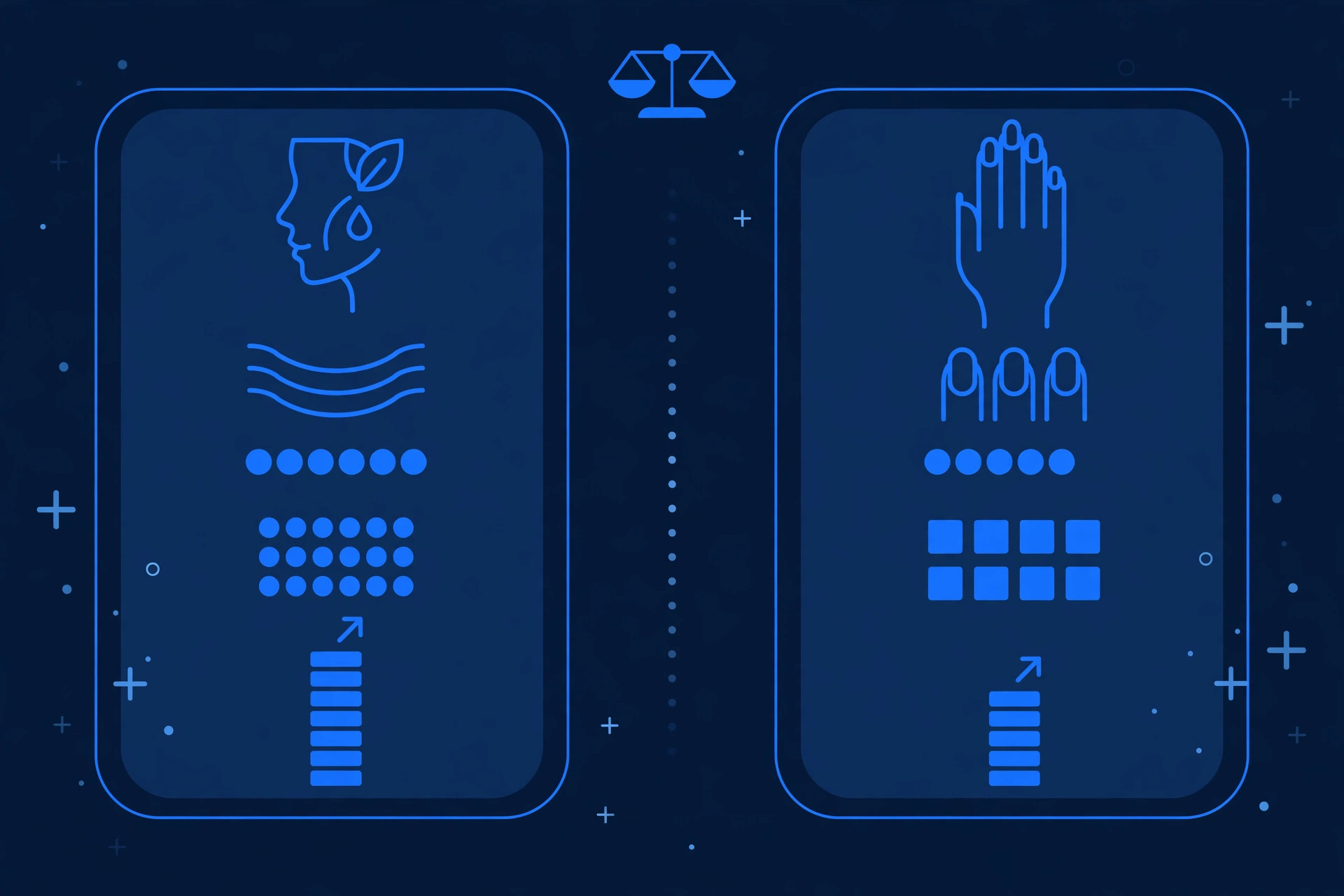
Esthetician vs nail tech is a choice between two focused licenses, not a long and a short version of the same one. An esthetician license covers skin only: facials, skin analysis, hair removal, and makeup. A nail technician license covers nails only: manicures, pedicures, and enhancements. Your daily work, training time, exam, and pay all follow from that split.
Esthetician vs nail tech: side by side
| Esthetician license | Nail technician license | |
|---|---|---|
| Legal scope | Skin only | Nails only |
| Main work | Facials, skin analysis, exfoliation, masks, hair removal, makeup, lash and brow services | Manicures, pedicures, nail enhancements, nail art |
| Training hours (California example) | 600 hours | 400 hours (licensed as a manicurist) |
| NIC theory exam | 110 items (100 scored), 90 minutes | 110 items (100 scored), 90 minutes |
| Exam domains | Scientific Concepts 55%, Skin Care and Services 45% | Eight domains: enhancements 20%, manicure and pedicure services 18%, infection control 15%, anatomy and physiology 15%, tools 13%, chemistry 10%, pre-service 5%, post-service 4% |
| Passing standard | Set by your state; 75 is the most common standard | Set by your state; 75 is the most common standard |
| Exam fee | Set by your state and its testing provider; no national fee | Set by your state and its testing provider; no national fee |
| BLS occupation | Skincare specialists | Manicurists and pedicurists |
| 2025 median pay (BLS) | $45,330 per year ($21.79 per hour) | $35,760 per year ($17.19 per hour) |
| Pay range, 10th to 90th percentile (BLS) | Under $14.22 to over $39.45 per hour | Under $13.90 to over $24.10 per hour |
| Jobs, 2025 (BLS) | 104,200 | 201,800 |
| Projected growth, 2025–35 (BLS) | 9% | 9% |
| Typical settings | Salons, spas, offices of physicians | Nail salons, spas, hair salons |
(Sources: NIC Esthetics Theory CIB; NIC Nail Technology Theory CIB, 2025 update; California Board of Barbering and Cosmetology — Exam Quick Tips; BLS — Skincare Specialists; BLS — Manicurists and Pedicurists. Hours, fees, and passing scores are set by your state board — the hours row is California's requirement, not a national rule.)
Figures are U.S. national medians for each occupation — half of workers earn more, half earn less. They are not a promise of any individual's pay: actual wages vary by state, employer, and experience, and certification alone does not guarantee a salary.
What does each license actually let you do?
This is the part to get right before you pay for school, because each license quietly blocks you from the other one's services. An esthetician license does not authorize nail services, and a nail technician license does not authorize facials or other skin treatments. If the service menu you picture yourself offering mixes both, neither license alone covers it, and the broader license that covers hair, skin, and nails is cosmetology, a longer program than either of these.
Estheticians, listed by BLS as skincare specialists, evaluate a client's skin condition, discuss treatments, and provide facials, full-body treatments, masks, peels, and scrubs. They remove unwanted hair using wax or other approved treatments, apply makeup, recommend skincare products, and refer clients with serious skin problems to a dermatologist (BLS — Skincare Specialists). The NIC esthetics outline adds eyelash and eyebrow services, body treatments such as wraps and sunless tanning, and advanced topics such as microdermabrasion where your state allows them (NIC Esthetics Theory CIB).
Nail technicians, listed by BLS as manicurists and pedicurists, clean, trim, and file nails, soften calluses, massage and moisturize hands and feet, polish or buff nails, and apply or remove artificial nails and nail art (BLS — Manicurists and Pedicurists). BLS describes the work plainly: manicurists and pedicurists work exclusively on the hands and feet. Within that narrow scope, the modern nail menu is deep: the NIC nail outline covers nail tips, acrylics, soft, hard, and hybrid gels, and powder dip systems (NIC Nail Technology Theory CIB, 2025 update).
How long is school for each license?
Training hours are set by your state, so there is no national number for either license. California shows the usual relationship: a Board-approved course is 600 hours for an esthetician and 400 hours for a manicurist, so the nail program runs about two-thirds the length of the esthetics program in that state (California Board of Barbering and Cosmetology — Exam Quick Tips). Your state's split will differ, so pull both hour requirements from your own state board before you visit a school.
Two cautions belong here. First, some states license nail technicians under the name "manicurist," as California does, so search your board's site under both names. Second, BLS notes for both occupations that licensing requirements vary by state and that you should check with your state licensing agency for details (BLS — Manicurists and Pedicurists; BLS — Skincare Specialists). A shorter program gets you licensed and earning sooner, and the trade is a narrower license.
How do the two NIC theory exams compare?
The two exams look identical from the outside. Each contains 110 items, of which 100 are weighted and contribute to your final score, and each allows 90 minutes (NIC Esthetics Theory CIB; NIC Nail Technology Theory CIB, 2025 update). That works out to roughly 49 seconds per question on either exam, including the 10 unscored items you cannot identify.
Inside, they test different kinds of depth. The esthetics exam has only two domains: Scientific Concepts at 55% and Skin Care and Services at 45% (NIC Esthetics Theory CIB). More than half of your esthetician exam is science: microbiology, infection control, anatomy and physiology, skin histology, disorders and diseases, and basic chemistry including pH. Candidates who enroll expecting facials and makeup are often surprised by how much of the test is science.
The nail technology exam, in its 2025 update, spreads the same 100 scored questions across eight domains: Application, Maintenance and Removal of Nail Enhancements at 20%, Manicure and Pedicure Services at 18%, Infection Control and Safety Practices at 15%, Anatomy and Physiology at 15%, Nail Service Tools at 13%, Chemistry of Nail Products at 10%, the Pre-service Process at 5%, and Post-Service Procedures at 4% (NIC Nail Technology Theory CIB, 2025 update). No single topic dominates the way science dominates esthetics, but enhancements, which school practice time often shortchanges, is the biggest block.
The passing standard is set by your state for both exams. The most common standard is 75: Washington requires a passing scaled score of 75 (Washington Administrative Code 308-20-120), while some states require 70, as Tennessee does for estheticians (PSI Tennessee Esthetician Test Taker Guide). Confirm your own state's number in its candidate bulletin before test day.
And take both exams seriously. California is the one state that publishes outcome data, and its overall pass rate in 2022 was 65% for estheticians and 61% for manicurists (California Board of Barbering and Cosmetology, Jan. 9, 2023 memo). Those are California figures only, because NIC does not publish a national pass rate, but the point stands: roughly 1 in 3 candidates there did not pass, on either exam.
Which license pays more, and where do you work?
On national medians, the esthetician license pays more. Skincare specialists earned a median of $45,330 per year, or $21.79 per hour, in May 2025, while manicurists and pedicurists earned a median of $35,760 per year, or $17.19 per hour (BLS — Skincare Specialists; BLS — Manicurists and Pedicurists). Read the ranges, not just the medians: the lowest 10% of skincare specialists earned less than $14.22 per hour and the highest 10% earned more than $39.45, while the lowest 10% of manicurists and pedicurists earned less than $13.90 and the highest 10% earned more than $24.10 (BLS — Skincare Specialists; BLS — Manicurists and Pedicurists). Setting moves an esthetician's pay in particular: skincare specialists working in offices of physicians earned a median of $24.81 per hour in May 2025, above the occupation's overall median (BLS — Skincare Specialists).
The nail side answers with volume and independence. Manicurists and pedicurists held about 201,800 jobs in 2025, nearly twice the 104,200 skincare specialist jobs, and BLS projects about 21,900 openings a year for manicurists and pedicurists against about 14,200 for skincare specialists, with both occupations projected to grow 9% from 2025 to 2035 (BLS — Manicurists and Pedicurists; BLS — Skincare Specialists). Self-employment is common in both fields: 29% of skincare specialists and 23% of manicurists and pedicurists were self-employed in 2025 (BLS — Skincare Specialists; BLS — Manicurists and Pedicurists). Work settings differ, too: skincare specialists usually work in salons and beauty and health spas, and some work in medical offices, while manicurists and pedicurists usually work in a nail salon, spa, or hair salon (BLS — Skincare Specialists; BLS — Manicurists and Pedicurists).
Choose your license: the neutral verdict
- Choose the esthetician license if skin is the work you actually want: analyzing skin, giving facials and body treatments, removing hair, and advising clients on products and routines. You accept a longer program in exchange for higher median pay and medical-spa and physician-office settings.
- Choose the nail technician license if nails are the craft you want to master: manicures, pedicures, enhancements, and nail art, with detailed hand work finished in a single appointment. You get the shorter program and the larger job market, in exchange for a lower median wage and a license that stops at the hands and feet.
- Choose cosmetology instead if you cannot yet give up either menu, or you also want hair. It covers skin and nails at introductory depth, in a longer program than either license here, and you can add a focused license later.
- Choose based on your state's numbers if you are still torn: pull your state board's hours, fees, and passing standard for both licenses, and weigh the extra school time for esthetics against the pay and setting differences above. The right answer is the license whose daily work you would still choose after reading its exam outline.
What this comparison cannot tell you
This article can lay the two licenses side by side, but it cannot tell you how you would score on either exam, and that matters more than it sounds. The esthetician exam leans on science, and the nail tech exam puts its biggest weight on enhancements. If you are leaning one way, the cheapest way to test that lean is to sit a short set of real-format questions and see whether the content holds your attention and where your knowledge already stands.
Upward Prep offers a free 10-question diagnostic for each exam: the free 10-question esthetician diagnostic is built on the 55/45 blueprint, and the free 10-question nail technician diagnostic is built on the eight-domain 2025 blueprint. Take the one for the license you are leaning toward, or take both. Your results, broken down by topic, will tell you more about your fit than any comparison table, including this one.
Frequently asked questions
esthetician vs nail tech
An esthetician license covers skin only: facials, skin analysis, hair removal, and makeup. A nail technician license covers nails only: manicures, pedicures, and enhancements. In California, the training is 600 hours for an esthetician and 400 hours for a manicurist (California Board of Barbering and Cosmetology — Exam Quick Tips), and on BLS medians skincare specialists earn more per hour while manicurists and pedicurists hold more jobs (BLS — Skincare Specialists; BLS — Manicurists and Pedicurists).
how long is esthetician school
It depends on your state, because hours are state-set. California requires a 600-hour Board-approved course for estheticians (California Board of Barbering and Cosmetology — Exam Quick Tips). Check your own state board for its requirement, and ask schools whether their hours run full-time or part-time, since the same count can mean very different calendars.
how long is nail tech school
It also depends on your state. California requires a 400-hour Board-approved course for a manicurist, its name for the nail license (California Board of Barbering and Cosmetology — Exam Quick Tips). Some states use the title nail technician instead of manicurist for the same license, so search your board's site under both names.
esthetician salary
Skincare specialists, the BLS occupation that covers estheticians, earned a median of $45,330 per year ($21.79 per hour) in May 2025. The range is wide: the lowest 10% earned less than $14.22 per hour and the highest 10% earned more than $39.45, and skincare specialists in offices of physicians earned a median of $24.81 per hour (BLS — Skincare Specialists).
nail technician salary
Manicurists and pedicurists, the BLS occupation that covers nail technicians, earned a median of $35,760 per year ($17.19 per hour) in May 2025. The lowest 10% earned less than $13.90 per hour and the highest 10% earned more than $24.10 (BLS — Manicurists and Pedicurists). BLS counted about 201,800 manicurist and pedicurist jobs in 2025, with about 21,900 openings projected each year.