
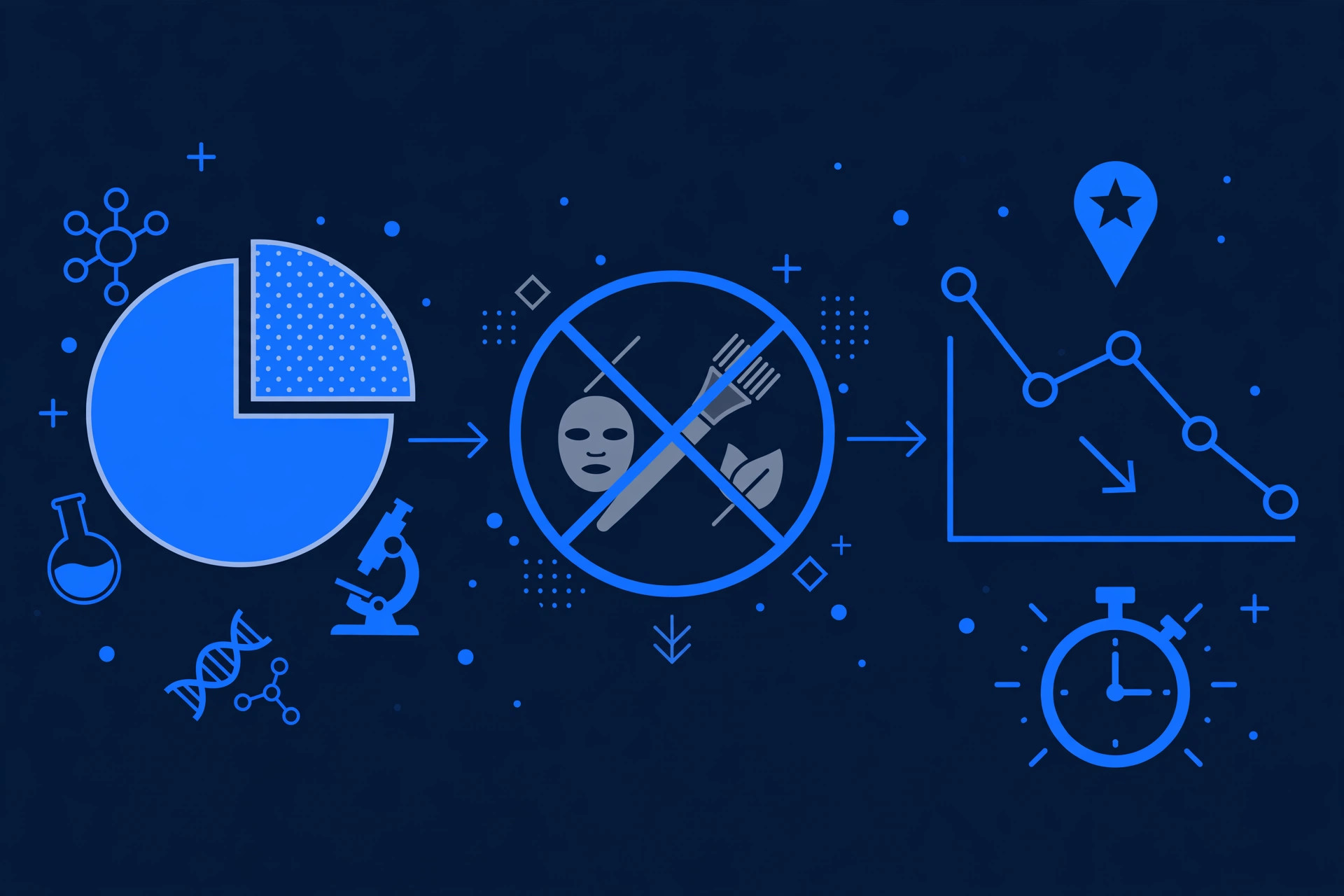
Is the esthetician exam hard? Yes — moderately, and in a specific way: 55% of the NIC theory exam is Scientific Concepts, not facials, and California candidates passed at only 65% in 2021 and 2022. It is passable, but the science, skin-disorder detail, and roughly 49-second pacing surprise candidates who studied mostly hands-on services.
Try 3 real Esthetician questions
Real questions from the Esthetician bank, with the cited explanation for every answer. Tap an answer to check it.
1. Antiseptics are designed to be used:
Antiseptics are chemical agents formulated for use on living skin to reduce microbial counts. They are milder than disinfectants.
Source: Milady Standard Esthetics: Fundamentals
2. Compared to oil-in-water products, water-in-oil emulsions:
Water-in-oil (W/O) emulsions have water droplets dispersed in an oil base — they feel richer, are more occlusive/moisturizing, and resist rinsing off with water (e.g., cold creams, night creams).
Source: Milady Standard Esthetics: Fundamentals
3. Electrical grounding in salon equipment:
Grounding provides a safe, low-resistance path for stray electrical current to flow into the earth, protecting the operator and client from shock.
Source: Milady Standard Esthetics: Fundamentals
The honest answer: it's a science exam wearing a facial mask
Most people choose esthetics because they like skin care — facials, extractions, masks, helping clients relax and look better. Then they open the official test plan and discover the exam's centre of gravity is somewhere else entirely.
Under the NIC blueprint, Domain I, Scientific Concepts, carries 55% of the exam, while Domain II, Skin Care and Services, carries 45% (NIC Esthetics Theory CIB). In plain terms: about 55 of your 100 scored questions are science, and about 45 are services.
That single fact explains most failures. Candidates prepare in proportion to what school felt like — lots of hands-on services, some theory on the side — and then sit an exam weighted the other way. The exam is not unfair, and it is not advanced-degree science. It is just heavier on microbiology, infection control, anatomy, skin disorders, and basic chemistry than most candidates expect.
So: hard if you study for the exam you imagined, manageable if you study for the exam that actually exists.
What the exam actually looks like
The NIC National Esthetics Theory Examination is the written licensure exam developed by the National-Interstate Council of State Boards of Cosmetology (NIC), and its Candidate Information Bulletin (effective 1/2020) sets the format (NIC Esthetics Theory CIB):
| Exam fact | What the NIC CIB says |
|---|---|
| Total items | 110 |
| Scored items | 100 (10 are unscored pretest items) |
| Time allowed | 90 minutes |
| Domains | 2 — Scientific Concepts and Skin Care and Services |
| Official references named in the CIB | Standard esthetics textbooks, including Milady and Pivot Point |
The 10 pretest items matter for strategy: they are mixed in with the scored questions and you cannot tell them apart, so there is no benefit in trying to guess which questions "don't count." Treat every item as scored.
Your state board sets the passing standard and the licensing rules around the exam, so confirm your own state's requirements before test day rather than relying on a number you read for another state.
The 55/45 blueprint, in plain language
Here is what each domain actually covers, summarised from the official outline (NIC Esthetics Theory CIB):
| Domain | Weight | What it covers, in brief |
|---|---|---|
| D1: Scientific Concepts | 55% | Microbiology; infection control levels and methods; safety, standard precautions, blood-exposure steps, safety data sheets and chemical handling; cells, tissues, organs and body systems; skin structure, glands and functions; skin disorders and diseases; hair structure and growth; basic chemistry, ingredients, labelling and pH |
| D2: Skin Care and Services | 45% | Client consultation and records; client protection and draping; skin analysis, including Fitzpatrick types; contraindications; treatment protocols; cleansing, steaming, exfoliation, massage movements and extractions; mask types; finishing a facial; electrical equipment; makeup; and other services including hair removal |
Look at the D1 row again. That is a lot of memorised science for a licence many people pursue for the treatment room. It is also — and this is the encouraging part — highly learnable. Most of it is definitions, classifications, and ordered procedures, not problem-solving.
The numbers: what California's pass rates actually tell you
NIC does not publish a national pass rate, so be sceptical of any site quoting a single national figure without a source. The best published series we have is from California, one of the largest testing states.
The California Board of Barbering and Cosmetology reported these overall esthetician pass rates in its January 9, 2023 Licensing and Examinations Committee memo (California Board of Barbering and Cosmetology, Jan. 9, 2023 memo):
| Year | CA overall pass rate | Implied fail rate |
|---|---|---|
| 2018 | 76% | 24% |
| 2019 | 79% | 21% |
| 2020 | 73% | 27% |
| 2021 | 65% | 35% |
| 2022 | 65% | 35% |
Three honest caveats about this table:
- These are California figures only. Your state's results may be higher or lower. Do not treat 65% as a national rate.
- The early years were not written-only. Before 2022, California's figures combined the written and practical examinations. California eliminated its practical examination in January 2022, so the 2022 figure is written-only (California Board of Barbering and Cosmetology meeting materials, Jan. 22, 2024).
- Language made a real difference in the same data. In that memo, candidates who took the California exam in Spanish passed at 45% in 2022, and between 38% and 45% across 2018–2022 — well below the overall rate (California Board of Barbering and Cosmetology, Jan. 9, 2023 memo). That gap is a reminder that this exam tests precise technical vocabulary, not just practical know-how.
The trend is the takeaway: recent fail rates around 35% in California mean roughly one in three candidates did not pass. That is a real gate — not a formality, and not an impossible wall.
What actually makes it hard: five honest factors
1. More than half the exam is science
This bears repeating because it drives everything else. Microbiology, infection control, anatomy and physiology, skin histology, disorders and diseases, hair, and chemistry together make up the 55% domain (NIC Esthetics Theory CIB). If your study plan mirrors your school timetable — mostly services — it is weighted wrong for this test.
2. Skin disorders are a memorisation trap
Inside D1, the outline expects you to recognise disorders of the sebaceous and sweat glands, contagious diseases, inflammations, pigmentation problems, growths, skin cancers, and primary versus secondary lesions (NIC Esthetics Theory CIB). These questions reward exact terminology. Knowing roughly what a condition looks like is not enough if you cannot match its official name to its description — and two answer choices often describe similar-looking conditions.
3. Infection control rewards exact levels and order
The outline separates levels of infection control — sanitation, disinfection, and sterilization — from methods such as heat and chemical agents, and it adds standard precautions, blood-exposure procedures, safety data sheets, and chemical handling (NIC Esthetics Theory CIB). Candidates lose points here by knowing the general idea but mixing up which level a product or procedure reaches. This is rote material: unglamorous, and very scoreable if you drill it.
4. The pacing is about 49 seconds a question
Ninety minutes for 110 items is about 49 seconds per item (derived from the NIC CIB's 90-minute limit and 110-item count (NIC Esthetics Theory CIB)). That is fast for questions that may describe a client scenario before asking what to do next. There is no separate section for quick recall questions — they sit alongside longer items. Candidates who read every question twice, or stall on one hard item, run out of clock. The fix is a habit, not knowledge: answer what you know, flag what you don't, and keep moving.
5. Chemistry shows up quietly
Basic chemistry sits inside D1 — ingredients, labelling, product functions, and acidity/alkalinity, meaning pH (NIC Esthetics Theory CIB). It is a smaller slice than infection control or skin disorders, but it is the topic students most often say they "skipped" in school — and skipped topics are exactly where a 55%-science exam collects its failures.
The services domain is not the free pass it looks like
It is tempting to treat D2 as the easy 45%. Don't. The services outline still tests consultation and documentation, client protection, skin analysis including Fitzpatrick types, contraindications, treatment protocols, cleansing, steaming, exfoliation, massage movements, extractions, mask types, electrical equipment, makeup, and hair removal (NIC Esthetics Theory CIB).
The trap is familiarity. Because you have performed these services, you may answer from how your school or spa does them. The exam asks for the textbook-standard method and the safety-first choice — for example, recognising a contraindication and refusing or modifying a service. Hands-on confidence helps here, but it does not replace reading the standard procedure.
A note on the practical exam
Be clear about what this article — and any multiple-choice practice bank, including ours — covers: the written theory exam only.
Some states still require a separate hands-on practical examination in addition to the theory exam; others do not. California, for example, eliminated its practical examination in January 2022 (California Board of Barbering and Cosmetology meeting materials, Jan. 22, 2024). Check your own state board to see whether a practical is part of your path, and do not let anyone sell you theory practice as practical preparation. They are different skills.
How to make this exam easier: study the way it's weighted
- Give science the majority of your time. Roughly 55% of your study hours belong to D1 — infection control first, then skin structure and disorders, then anatomy, microbiology, hair, and chemistry, following the blueprint weights in the CIB (NIC Esthetics Theory CIB).
- Learn names, not just pictures. For disorders, lesions, glands, and skin layers, drill the official term alongside the description. Terminology gaps are a documented weakness on this kind of exam — California's Spanish-language pass rates, far below its overall rates in the Board's own data, underline how much wording matters (California Board of Barbering and Cosmetology, Jan. 9, 2023 memo).
- Memorise infection control as levels and steps. Sanitation versus disinfection versus sterilization, plus the blood-exposure sequence, in order, cold.
- Practise at test pace. Timed sets at roughly 49 seconds a question teach the flag-and-return discipline the real clock demands. Untimed review builds knowledge; timed practice builds a passing performance.
- Use your services knowledge, then check it against the standard. After each practice set, review the D2 questions you missed and note where your workplace habit differed from the textbook answer.
What this article can't do for you
Reading a breakdown tells you what the exam is. It cannot tell you where you stand on it — whether your infection control is solid but your skin disorders are shaky, or whether your pacing collapses after question 60. No article can score you.
That measurement is the useful next step. Our free 25-question NIC Esthetician diagnostic is weighted to the same 55/45 blueprint as the real exam, so your result shows which domain would hurt you on test day — while there's still time to fix it.
Take the free 25-question esthetician practice test → — see whether the science half is ready, before the state board tells you.
Frequently asked questions
is the esthetician exam hard
Yes, moderately — mainly because 55% of the NIC theory exam is Scientific Concepts rather than hands-on services, and you get about 49 seconds per question (NIC Esthetics Theory CIB). California's overall pass rate was 65% in both 2021 and 2022, so about one in three California candidates failed (California Board of Barbering and Cosmetology, Jan. 9, 2023 memo). It is passable with science-first study.
what is the hardest part of the esthetician exam
For most candidates, the science domain: infection control levels, skin disorders and diseases, skin anatomy, and basic chemistry including pH — all inside the 55% Scientific Concepts domain (NIC Esthetics Theory CIB). These topics reward exact terminology and memorised procedures, which is different from the hands-on skill school trains most.
how many questions are on the esthetician exam
The NIC theory exam has 110 items: 100 scored questions plus 10 unscored pretest items you cannot identify (NIC Esthetics Theory CIB).
how long is the esthetician exam
The time allowed is 90 minutes for all 110 items — about 49 seconds per question (NIC Esthetics Theory CIB).
what is the pass rate for the esthetician exam
There is no published national pass rate — NIC does not publish one. The clearest published series is California's: overall pass rates of 76% in 2018, 79% in 2019, 73% in 2020, and 65% in both 2021 and 2022 (California Board of Barbering and Cosmetology, Jan. 9, 2023 memo). Figures before 2022 combined California's written and practical exams; California eliminated the practical in January 2022, so 2022 was written-only (California Board of Barbering and Cosmetology meeting materials, Jan. 22, 2024).
what score do you need to pass the esthetician exam
Your state board sets the passing standard for licensure, and it is not stated in the NIC Candidate Information Bulletin itself — so check your state board's current bulletin before test day rather than trusting a single number quoted for another state (NIC Esthetics Theory CIB).
what happens if you fail the esthetician exam
Retake rules, waiting periods, and fees are set by your state board, not by NIC, so the exact process varies by state — confirm yours with your board. The productive response is diagnostic: most failures trace back to the 55% Scientific Concepts domain, so re-study infection control, skin disorders, and anatomy first, and practise at test pace before you rebook (NIC Esthetics Theory CIB).