
What's Actually on the Florida Core Exam: Topic-by-Topic Breakdown
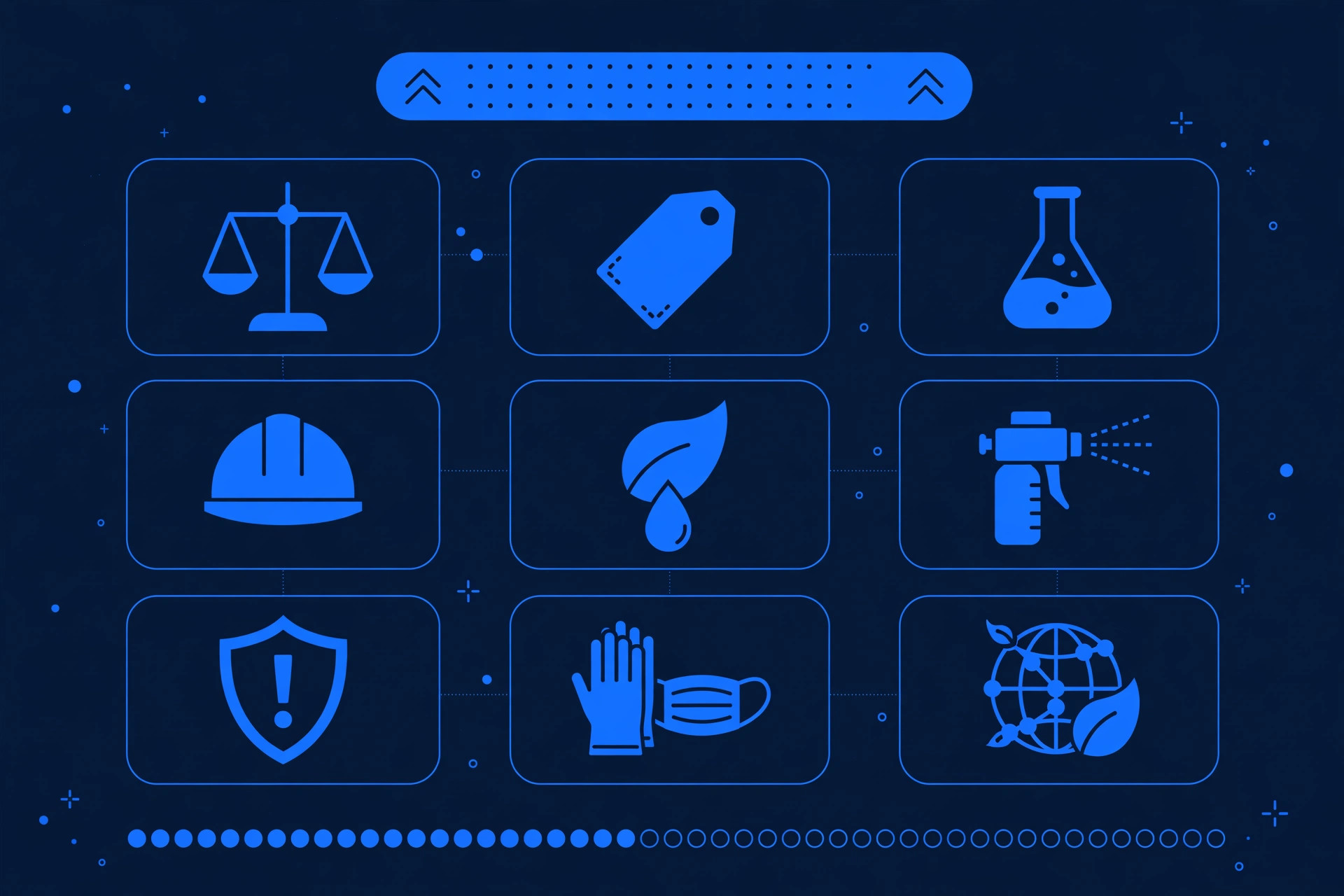
What is on the Florida Core exam? Nine topics drawn from one manual, Applying Pesticides Correctly (SM-1): pesticide law, pest-control principles, labels, formulations, environmental effects, harmful effects and emergency response, protective equipment, transport and storage, and application procedures (UF/IFAS Extension Polk County) — tested as 50 multiple-choice questions (UF/IFAS Extension Lake County).
Try 3 real Florida Core questions
Real questions from the Florida Core bank, with the cited explanation for every answer. Tap an answer to check it.
1. A sprayer tank holds 200 gallons, and calibration shows the sprayer applies 25 gallons per acre. How many acres will one full tank cover?
Acres per tank = tank capacity ÷ gallons per acre. Here: 200 gal ÷ 25 gal/acre = 8 acres. This is the standard calibration step that tells the applicator how much product to add per tankful for the acres it will cover.
2. A label states, "Do not allow spray drift to contact non-target plants, as injury may occur." A neighboring property has a vegetable garden downwind of the treatment area. What must the applicator do?
Drift restrictions are binding label directions designed to protect non-target plants, people, and property. The applicator must manage the application — timing, equipment, buffers, or delaying — so drift does not contact the downwind garden.
3. An applicator mixes 1 gallon of 40% concentrate with enough water to make 100 gallons of finished spray. What is the percent active ingredient in the finished spray?
First find the active ingredient: 1 gal × 0.40 = 0.4 gal of AI. Then divide by the total spray volume: 0.4 gal ÷ 100 gal = 0.004 = 0.4%. Dilution problems always use the finished total volume as the denominator.
Where this breakdown comes from
Unlike the NHA exams, the Florida Core exam has no domain table with official question counts. What Florida publishes instead is a topic list. UF/IFAS Extension Polk County lists the nine areas the General Certification Standards (Core) Exam covers, and notes the exam is based on SM-1, Applying Pesticides Correctly, by Frederick M. Fishel (UF/IFAS Extension Polk County). The UF/IFAS Bookstore describes the same manual chapter by chapter, from the law and pesticide application through pesticide application procedures (UF/IFAS Bookstore).
Florida law points the same way. Section 487.044, Florida Statutes, requires every applicant to demonstrate minimum competence in equipment use, environmental hazards, calculating concentrations, pest identification, protective clothing, disposal and decontamination, state and federal pesticide laws, and general safety precautions (Florida Statutes § 487.044). Read the nine topics below as that competence list, expanded into a study manual.
One honest warning: no UF/IFAS or FDACS source publishes how many of the 50 questions fall in each topic. Any site giving you exact percentages per topic is inventing them. Cover all nine topics, and put extra repetitions into the ones that reward exact recall.
The nine topics at a glance
| # | Topic (SM-1 chapter) | What it tests, in plain English |
|---|---|---|
| 1 | The law and pesticide application | FIFRA, Florida's Chapter 487, who regulates what, and the Private / Public / Commercial license classes |
| 2 | Principles of pesticides and pest control | Identifying the pest first, integrated pest management, and when treatment is actually justified |
| 3 | Understanding pesticide labeling | Reading a label as a legal document: signal words, precautionary statements, directions for use |
| 4 | Pesticide formulations | Active vs. inert ingredients, and the liquid and dry forms a product can take |
| 5 | Pesticides and the environment | Drift, runoff, groundwater, and harm to non-target organisms |
| 6 | Harmful effects and emergency response | Toxicity, exposure routes, and what to do when something goes wrong |
| 7 | Personal protective equipment | The protective clothing and respiratory equipment the work requires |
| 8 | Transportation, storage, security, and disposal | Moving, storing, securing, and getting rid of pesticides and their wastes safely |
| 9 | Pesticide application procedures | Equipment, application methods, and the calibration calculations behind them |
Topic names and order follow UF/IFAS Extension Polk County and the SM-1 chapter list (UF/IFAS Extension Polk County; UF/IFAS Bookstore).
1. The law and pesticide application
This is the rules chapter, and it rewards exact facts over reasoning. The federal framework is the Federal Insecticide, Fungicide, and Rodenticide Act (FIFRA), enforced by the EPA, which registers pesticide products; in Florida, the Florida Department of Agriculture and Consumer Services (FDACS) administers applicator licensing (Morning Ag Clips Agricultural Pesticide Applicator Licensing FAQ). The Core exam certifies applicators under the Florida Pesticide Law and its rules, and FDACS issues the licenses (UF/IFAS Extension Polk County).
Expect questions on the three applicator classes under Chapter 487. A private license covers using restricted use pesticides to produce agricultural commodities on your own land or your employer's; a public license covers government agency employees; a commercial license covers everything else, including all for-hire applications (FDACS Pesticide Certification FAQ). You also need the restricted-use pesticide (RUP) idea cold: anyone using or supervising restricted use pesticides on agricultural or related sites in Florida needs a license (FDACS Pesticide Certification FAQ).
Study this chapter with flashcards — agency roles and license classes are either known or not known on exam day.
2. Principles of pesticides and pest control
This chapter is about judgment before chemistry: identify the problem before you reach for a product. Florida's statute makes pest identification an examinable competence — knowledge of common pests and the damages they cause (Florida Statutes § 487.044).
Integrated pest management (IPM) sits at the center of this topic. UF/IFAS Extension Pasco County describes IPM as an approach that prioritizes the least harmful methods to control insects, plant diseases, and weeds, starting with identifying the pest and setting action thresholds — the level of damage at which action is warranted (UF/IFAS Extension Pasco County). UF/IFAS Extension Manatee County makes the same sequence explicit: identify the pest first, because the wrong identity leads to the wrong treatment, then judge the population against the threshold before acting (UF/IFAS Extension Manatee County).
Questions here test whether you spray by calendar or by evidence. The defensible answer is almost always the IPM sequence — identify, monitor, compare against a threshold, then choose the least harmful effective method.
3. Understanding pesticide labeling
If one topic deserves the most study time, it is this one. The Core exam treats the pesticide label as a legal document, not a suggestion sheet, and this chapter teaches you to read every section of it: the product name and ingredients, the signal word, precautionary statements, directions for use, and storage and disposal directions (UF/IFAS Extension Polk County; UF/IFAS Bookstore).
The signal words are the highest-yield detail. UF/IFAS defines them by relative hazard: Danger is the signal word used on labels of highly hazardous pesticides, Warning marks pesticides considered moderately toxic or hazardous, and Caution is used on slightly toxic or relatively nontoxic pesticides (UF/IFAS Plant Management in Florida Waters — Herbicide Labels).
Do not just read about labels. Work through real sample labels section by section until you can say what each part does. Label questions are where careful readers gain points that skimmers lose.
4. Pesticide formulations
A formulation is what is in the container: the active ingredient plus inert ingredients that make the product usable. UF/IFAS's formulations guide, drawn from Applying Pesticides Correctly, defines the active ingredient as the substance intended to kill, repel, or otherwise control the target pest, with the rest of the mixture made up of inert ingredients (UF/IFAS Citrus Research and Education Center — Understanding Pesticide Formulations).
The exam expects you to recognize the common forms and their abbreviations. Emulsifiable concentrates (E or EC) contain a liquid active ingredient with solvents and an emulsifier so the product mixes with water; wettable powders (WP) are dry formulations mixed with water for application, alongside granules, dusts, baits, and dry flowables (UF/IFAS Citrus Research and Education Center — Understanding Pesticide Formulations). You also need the label arithmetic: dry products state active ingredient as a percentage by weight, while liquids state it in pounds per gallon (UF/IFAS Citrus Research and Education Center — Understanding Pesticide Formulations). The formulation determines how a product is mixed, what exposure risks it carries, and how its rate is calculated.
5. Pesticides and the environment
This chapter covers what happens after spraying: drift, runoff and leaching toward water, and harm to organisms you were never aiming at. It is one of the nine Core areas listed by UF/IFAS Extension Polk County (UF/IFAS Extension Polk County), and Florida law names the underlying competence directly: applicants must demonstrate knowledge of the environmental hazards that may be involved in applying restricted-use pesticides (Florida Statutes § 487.044).
Study this topic as cause and effect. Weather, droplet size, and site conditions decide whether a legal application stays on target. Questions tend to present a scenario — wind picking up, a water body nearby — and the correct decision is the one that keeps the pesticide on the target and out of everywhere else.
6. Harmful effects of pesticides and emergency response
Pesticides can hurt the applicator, and this chapter covers how: the toxicity of a product, the routes by which it can enter the body, and the emergency response when an exposure or spill happens. It is a named SM-1 chapter — harmful effects of pesticides and emergency response (UF/IFAS Bookstore) — and it ties back to the label chapter, because a product's signal word is based on its acute toxicity: highly toxic products carry DANGER, moderately toxic products carry WARNING, and products low in acute toxicity carry CAUTION (UF/IFAS Hendry County — Understanding the Toxicity and Hazard Posed by Pesticides).
Florida's statute frames the same ground as general safety precautions, a minimum competence every applicant must demonstrate (Florida Statutes § 487.044). Expect scenario questions where first steps and correct order matter more than definitions.
7. Personal protective equipment
PPE is its own SM-1 chapter and its own exam topic (UF/IFAS Extension Polk County; UF/IFAS Bookstore). Florida law requires applicants to demonstrate knowledge of the protective clothing and respiratory equipment required during the handling and application of restricted-use pesticides (Florida Statutes § 487.044).
The key exam habit: PPE is specified by the product label, not by comfort or habit. Questions pair a product or task with equipment choices, and the right answer is the set the label requires. Treat this as exact recall, and let the label override what feels sufficient.
8. Transportation, storage, security, and disposal of pesticide wastes
This topic covers a pesticide's life outside the spray tank: transport, storage, security, and disposal of leftover product and empty containers. It is the eighth of the nine Core areas (UF/IFAS Extension Polk County) and a full SM-1 chapter (UF/IFAS Bookstore).
Florida law names the testable core: general precautions for the disposal of containers, and the cleaning and decontamination of equipment (Florida Statutes § 487.044). Expect concrete, procedural questions with one correct sequence. Work this material as checklists — the exam's wrong answers usually describe a shortcut that creates the very harm the rule prevents.
9. Pesticide application procedures
The final chapter is the hands-on one: equipment, application methods, and the calculations that deliver the labeled rate. UF/IFAS Extension Polk County lists pesticide application procedures as the ninth Core area (UF/IFAS Extension Polk County), and the statute requires competence in equipment use and calculating the concentration of restricted-use pesticides for particular circumstances (Florida Statutes § 487.044).
Calibration math lives here, and it is the most trainable part of the exam. Every problem follows the same sequence: measure the area, read the labeled rate and its units, then compute the total amount. Work that sequence in the same order every time, check units before arithmetic, and re-check the result — at 50 questions in 2 hours, about 2.4 minutes per question, you have time to verify a calculation instead of rushing it (UF/IFAS Extension Lake County).
How to study when there are no official weights
Because Florida publishes topics but not per-topic question counts, the honest study strategy is coverage first, emphasis second:
- Cover all nine topics. With 50 questions and a 70% pass mark — 35 correct — a whole topic ignored can cost you the exam (UF/IFAS Extension Gadsden County).
- Use the manual the way UF/IFAS advises. Read and study the manual, answer the questions at the end of each chapter, and understand the objectives at the beginning of each chapter (UF/IFAS Extension Lake County). Your chapter-end misses preview your exam misses.
- Give extra repetitions to exact-recall topics. Law, labels, and PPE reward memorized specifics; application procedures reward practiced calculations.
- Remember the Core is step one. You still take your category exam afterward, and adding categories later does not require retaking the Core (UF/IFAS EDIS PI292). No special qualification is needed to sit for the exam (UF/IFAS Extension Polk County), and testing runs through Everblue at $59 in-person or $32 remote online (UF/IFAS Extension Gadsden County).
Frequently asked questions
what is on the florida core exam
Nine topics drawn from Applying Pesticides Correctly (SM-1): the law and pesticide application, principles of pesticides and pest control, understanding pesticide labeling, pesticide formulations, pesticides and the environment, harmful effects and emergency response, personal protective equipment, transportation, storage, security, and disposal of pesticide wastes, and pesticide application procedures (UF/IFAS Extension Polk County; UF/IFAS Bookstore). They are tested as 50 multiple-choice questions in 2 hours (UF/IFAS Extension Lake County).
how many questions florida core pesticide exam
50 multiple-choice questions, with a 2-hour time limit — about 2.4 minutes per question. Category exams use the same 50-question, 2-hour format (UF/IFAS Extension Lake County).
is the florida core exam multiple choice
Yes. The Core exam is 50 multiple-choice questions. There are no essay, fill-in-the-blank, or oral sections (UF/IFAS Extension Lake County).
what is the passing score for the florida pesticide exam
70% — on the Core exam, that is 35 of 50 questions correct. The same 70% passing grade is required on all Florida pesticide exams, including every category exam (UF/IFAS Extension Gadsden County).
fdacs core exam study guide
The study guide for the Core exam is Applying Pesticides Correctly (SM-1) by Frederick M. Fishel — one manual covering law, pest-control principles, labels, formulations, environmental effects, harmful effects and emergency response, PPE, transportation and storage, and application procedures. It is $33 at the UF/IFAS Bookstore, and the exam is based on it (UF/IFAS Bookstore; UF/IFAS Extension Polk County).
What this breakdown can't do for you
A topic list tells you what to study. It cannot tell you which of the nine topics is your weak spot today — labels, law details, or calibration math. Only practice questions show you that.
The free Upward Prep 25-question Florida Core diagnostic can: take it timed, read the cited explanation for every miss, and you will know exactly which SM-1 chapters deserve your next study sessions before you pay the exam fee.