
NREMT AEMT Exam Changes: The New Scenario-Based Exam, En Route to Post Scene, Explained
The nremt aemt exam changes that matter most took effect July 1, 2024: the separate ALS psychomotor examination ended, and one scenario-based certification examination replaced it, with clinical judgment scenarios that follow a call through En Route, Scene, and Post Scene phases and new information arriving as you answer (NREMT — AEMT and Paramedic Certification Examinations, NREMT — ALS Psychomotor: Examination Discontinued).
Try 3 real NREMT AEMT questions
Real questions from the NREMT AEMT bank, with the cited explanation for every answer. Tap an answer to check it.
1. A 35-year-old woman who fell from a ladder is unresponsive with snoring respirations. You suspect spinal injury. How should you open the airway?
Correct. The jaw thrust opens the airway by displacing the mandible forward without extending the neck, protecting a potentially injured cervical spine. Source: AAOS, Emergency Care and Transportation of the Sick and Injured - Airway Management.
Source: AAOS, Emergency Care and Transportation of the Sick and Injured (12th ed.); Limmer & O'Keefe, Emergency Care (14th ed.)
2. You are sizing an oropharyngeal airway for an unresponsive apneic adult. What is the correct measurement?
Correct. OPA sizing is corner of mouth to earlobe; too long triggers vomiting, too short fails to displace the tongue.
Source: AAOS, Emergency Care and Transportation of the Sick and Injured (12th ed.); Jones & Bartlett, Advanced Emergency Care and Transportation of the Sick and Injured (4th ed.)
3. A 35-year-old has sudden dyspnea with unilateral absent breath sounds and chest pain after a coughing fit. SpO2 92%. What should you suspect?
Correct. Sudden unilateral absent breath sounds with dyspnea is spontaneous pneumothorax: oxygen and urgent transport.
Source: AAOS, Emergency Care and Transportation of the Sick and Injured (12th ed.); NAEMT, PHTLS: Prehospital Trauma Life Support (10th ed.)
What actually changed on July 1, 2024?
One examination replaced two. Before the redesign, AEMT candidates faced a cognitive examination and a separate ALS psychomotor examination. Under the ALS Assessment Redesign, the Registry discontinued the psychomotor examination and built the measurement of communication, leadership, and clinical judgment into the cognitive examination instead (NREMT — AEMT Examination Specifications).
The Registry gives two reasons in its own discontinuation notice: advancements in testing practices and testing science, and a consistent call for modernization and efficiency from stakeholders, and it notes that the move aligns with the requirements of the National Commission for Certifying Agencies (NCCA), its accreditation body (NREMT — ALS Psychomotor: Examination Discontinued).
| Before July 1, 2024 | Since July 1, 2024 |
|---|---|
| A cognitive examination plus a separate ALS psychomotor examination (NREMT — ALS Psychomotor: Examination Discontinued) | One AEMT Certification Examination, with no psychomotor examination required for National Registry certification (NREMT — Advanced Life Support Certification Examinations Key Initiative) |
| Hands-on skills were judged at a separate psychomotor testing event (NREMT — AEMT Examination Specifications) | Skills competency is a prerequisite handled before testing: candidates must meet the Recommended AEMT Student Minimum Competency (SMC) Matrix (NREMT — AEMT Candidate Handbook: Candidate Responsibilities) |
| Communication, leadership, and clinical judgment were not built into the cognitive examination in this form (NREMT — AEMT Examination Specifications) | Clinical Judgment is the largest domain at 31–35%, tested through unfolding scenarios, with communication and leadership built into the cognitive examination (NREMT — AEMT and Paramedic Certification Examinations, NREMT — AEMT Examination Specifications) |
The practical warning follows directly: study materials written for the pre-July-2024 examination describe a testing event that no longer exists, even where the underlying medicine in them is still sound.
What are the En Route, Scene, and Post Scene phases?
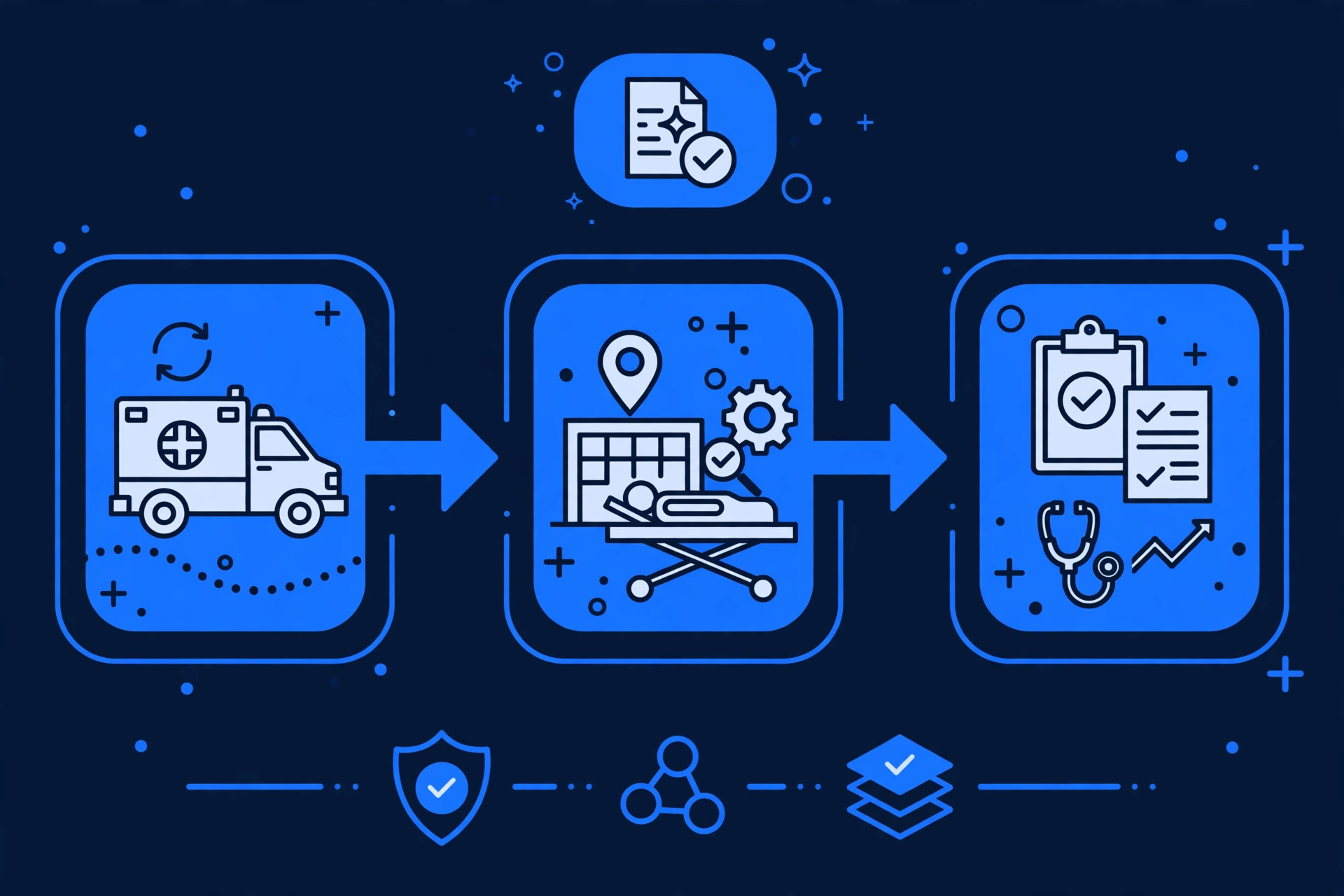
They are the three parts of a call, and the scenario follows them in order. The National Registry describes the new scenarios as presenting the three components of clinical judgment — en route, scene, and post-scene — so the items reflect what a practitioner experiences in the field and the decisions made in comprehensive patient care (NREMT — The National Registry's Launch of Scenario-Based Items for ALS Examinations). A scenario set works the same way in independent descriptions of the format: questions run the candidate through a scenario from En Route to on Scene to Post Scene, with additional information given after each question (Limmer Education / LC-Ready — NREMT Performance Scenarios).
| Phase | Where you are in the call | What the questions are really testing |
|---|---|---|
| En Route | You have the dispatch information, but you have not reached the patient yet | Whether you can form an early picture from limited information, anticipate what you may find, and prepare — the recognize and analyze steps of the judgment cycle, before any treatment is possible (NREMT — AEMT Examination Specifications) |
| Scene | You are with the patient, assessing and treating | Whether you can define a working hypothesis, choose an action inside the AEMT scope, and lead the call — the scenario format was built to measure communication, leadership, and clinical judgment together (NREMT — AEMT Examination Specifications) |
| Post Scene | The first treatments are done and the call is moving toward transport and handover | Whether you evaluate what your earlier treatments actually did, adjust the plan when the patient changes, and communicate the case clearly (JEMS — National Registry's New Computer-Based Performance Examination) |
One limit to keep straight: the Registry publishes the size of a whole scenario, not a fixed item count for each phase. The AEMT examination includes at least one scenario with 9 to 18 items (NREMT — The National Registry's Launch of Scenario-Based Items for ALS Examinations). Any source that promises an exact number of En Route questions is giving you a number the Registry has not published.
How is a scenario different from a normal set of questions?
A normal question gives you everything, asks one thing, and ends. A clinical judgment scenario keeps going.
The items work as an unfolding case: a scenario followed by a series of questions, presented one at a time, with new information added as you respond, designed to measure whether you evaluate the effect of earlier treatments and adjust your plan (JEMS — National Registry's New Computer-Based Performance Examination). That design changes what a good answer means. The right action early in the case can become the wrong action later, not because you misread the first question, but because the patient changed and the new information was the point.
Two scoring rules make that harder. First, you may change an answer before advancing, but once you submit it you cannot return to that item, and unanswered items at time-up are scored as incorrect (NREMT — AEMT Examination Specifications). Second, every item is scored in full or not at all (NREMT — AEMT Examination Specifications), so a multi-part answer that is mostly right still scores zero. In a scenario, that means an early decision you cannot take back can shape the information you are given next — exactly the pressure the format was built to create.
Are the phases the same as the clinical judgment steps?
No, and confusing them is a common study mistake. The phases are settings: where you are in the call. The steps are reasoning: what your mind does with the information in front of you, wherever you are.
Inside the Clinical Judgment domain, the test plan describes a repeating cycle: recognize cues, analyze cues, define a hypothesis, generate solutions, take action, and evaluate (NREMT — AEMT Examination Specifications). You can be asked to recognize cues on scene, and you can be asked to evaluate an earlier action while still on scene. The phase tells you the context. The step tells you the task. Reading a scenario question well means naming both before you look at the options: where am I in this call, and what kind of thinking is this question asking for?
The Registry's own sample packet is built to teach exactly that distinction. The packet contains clinical judgment scenario sample screens, definitions of clinical judgment that include aspects of leadership and communications, the steps used in clinical judgment, and sample items (NREMT — AEMT and Paramedic Certification Examinations). Work through it before test day, while the distinction is still free to learn.
What happened to the skills test?
It did not disappear. It moved, and it moved earlier.
Beginning July 1, 2024, a psychomotor examination is no longer a requirement for National Registry certification, while candidates should still check with their State EMS Office to determine state requirements (NREMT — Advanced Life Support Certification Examinations Key Initiative). In its place, eligibility now includes meeting the Recommended AEMT Student Minimum Competency (SMC) Matrix, alongside a current EMT-level certification or state license and successful completion of a state-approved AEMT course within the past two years, verified by the course Program Director (NREMT — AEMT Candidate Handbook: Candidate Responsibilities).
The SMC matrix guides State EMS Offices and AEMT programs in establishing state-approved standards to assess and verify a candidate's competency as a prerequisite for National Registry AEMT certification (NREMT — National Registry Board Meeting, June 2023: Public Notice). The Registry's position is that documented skills progression over time through the SMC is stronger evidence of competency than a single testing event (NREMT — ALS Psychomotor: Examination Discontinued).
What that means for you, practically: your program is now the place your hands-on competency is recorded, so a skills problem is something to fix during your course, not something you discover at a separate exam after it. And because states set their own standards under that guidance, the exact SMC requirements you must meet are your program's and your state's — ask your Program Director, not a national website, if you are unsure where you stand.
What does the rest of the current exam look like?
The scenario is the headline change, not the whole exam. The full current picture:
| Feature | Current AEMT examination |
|---|---|
| Items and time | 135 items in 3 hours, including 35 unscored pilot items you cannot identify (NREMT — AEMT Candidate Handbook: About the Examination) |
| Format | A linear computer-based test — every candidate receives the same number of items, though not identical items; it is not an adaptive test (NREMT — AEMT Examination Specifications) |
| Content basis | The test plan is determined through the 2019 National EMS Practice Analysis and the 2021 National EMS Practice Analysis Addendum (NREMT — AEMT and Paramedic Certification Examinations) |
| Largest domains | Clinical Judgment at 31–35%, then Medical, Obstetrics and Gynecology at 25–29% (NREMT — AEMT and Paramedic Certification Examinations) |
| Fee | $159, charged for each examination attempt (NREMT — AEMT and Paramedic Certification Examinations) |
| Item types inside scenarios | Technology-enhanced items are incorporated throughout the EMS scenarios, and candidates receive a tutorial on each item type at the beginning of the examination, with the instructions available through the Help function during it (NREMT — AEMT and Paramedic Certification Examinations) |
What if you started under the old system?
The transition rules were unforgiving about half-finished pathways, and they still explain some of the confusion you will hear from earlier cohorts. A candidate who had completed the cognitive examination by June 30, 2024, but not the psychomotor examination, was required to take the new AEMT Certification Examination starting July 1, 2024 — and the same applied in reverse, to a candidate who had completed the psychomotor examination but not the cognitive one (NREMT — AEMT and Paramedic Certification Examinations). Passing both parts before July 1, 2024, kept that certification valid, with the normal two-year renewal requirement (NREMT — AEMT and Paramedic Certification Examinations).
One thing the redesign did not change: the discontinuation of the ALS psychomotor examination does not alter the two-year eligibility period (NREMT — Advanced Life Support Certification Examinations Key Initiative). If you are testing now, none of the old pathways are available to choose between. There is one current examination, and the section above is its shape.
How should you study differently for a scenario-based exam?
Study the call, not just the facts behind it.
- Practice whole scenarios, in order. A scenario's later questions depend on information that arrives as you answer (JEMS — National Registry's New Computer-Based Performance Examination). Pulling single questions out of a set removes the skill the format tests.
- Name the phase and the step on every practice question. En Route, Scene, or Post Scene — then recognize, analyze, hypothesize, generate, act, or evaluate (NREMT — AEMT Examination Specifications). Misreading the task is a fixable error, and this habit fixes it.
- Reassess out loud after every treatment in a practice case. The scenario design measures whether you evaluate the effect of earlier treatments and adjust (JEMS — National Registry's New Computer-Based Performance Examination). Make that evaluation a reflex before it has to be one under time pressure.
- Weight your hours the way the exam does. Clinical Judgment at 31–35% and Medical, Obstetrics and Gynecology at 25–29% together carry well over half the examination (NREMT — AEMT and Paramedic Certification Examinations). An even split across all six domains does not match the test.
- Learn the interactive formats from the official source. Technology-enhanced items have been in the AEMT and Paramedic Certification Examinations since 2023, and the Registry publishes a sample packet and interactive sample items for them (NREMT — AEMT and Paramedic Certification Examinations).
One honest limit about our own product: Upward Prep's question bank is multiple-choice and does not replicate the interactive drag-and-drop or build-list mechanics; it covers the same sequencing, classification, and scenario reasoning in multiple-choice form. For the interactive mechanics themselves, use the Registry's own sample items (NREMT — AEMT and Paramedic Certification Examinations).
The bottom line: what this explainer cannot tell you
This article can give you the verified shape of the nremt aemt exam changes: one examination since July 1, 2024 (NREMT — AEMT Examination Specifications), scenarios that run En Route, Scene, and Post Scene (NREMT — AEMT and Paramedic Certification Examinations), and Clinical Judgment at 31–35% of the test (NREMT — AEMT and Paramedic Certification Examinations). What it cannot tell you is how you think through a case as it unfolds — whether you notice the new information, whether you re-evaluate a treatment that is not working, and which phase of the call costs you the most questions.
That is what a diagnostic is for. Upward Prep's free 25-question NREMT AEMT diagnostic breaks your result down by domain, with cited explanations, so you can see whether your judgment holds up across a scenario and where your study time belongs next. It will not predict a pass, and it does not replicate the interactive TEI mechanics — the Registry's own sample items are the place for those (NREMT — AEMT and Paramedic Certification Examinations).
Take the free 25-question NREMT AEMT practice test →
NREMT and National Registry of Emergency Medical Technicians are marks of the National Registry of Emergency Medical Technicians. Upward Prep is not affiliated with or endorsed by the National Registry.
Frequently asked questions
nremt aemt exam changes
The central change took effect July 1, 2024: the separate ALS psychomotor examination was discontinued, its last administration was June 30, 2024, and one scenario-based AEMT Certification Examination replaced it, with Student Minimum Competency requirements introduced as a prerequisite (NREMT — ALS Psychomotor: Examination Discontinued, NREMT — AEMT Examination Specifications).
nremt clinical judgment scenarios
A scenario is a series of questions built on one unfolding case, presenting the three components of clinical judgment — en route, scene, and post-scene — with new information added as you respond (NREMT — The National Registry's Launch of Scenario-Based Items for ALS Examinations, JEMS — National Registry's New Computer-Based Performance Examination). The AEMT examination includes at least one scenario with 9 to 18 items (NREMT — The National Registry's Launch of Scenario-Based Items for ALS Examinations), and Clinical Judgment is 31–35% of the examination (NREMT — AEMT and Paramedic Certification Examinations).
do aemts take a skills exam
Not as a separate National Registry examination anymore. Beginning July 1, 2024, a psychomotor examination is no longer a requirement for National Registry certification; instead, candidates must meet the Recommended AEMT Student Minimum Competency (SMC) Matrix through their program, and they should check with their State EMS Office for state requirements (NREMT — Advanced Life Support Certification Examinations Key Initiative, NREMT — AEMT Candidate Handbook: Candidate Responsibilities).
nremt aemt technology enhanced items
Technology-enhanced items use interactive response formats, including Build List, Drag-and-Drop, and Option/Check Box items, and on the AEMT examination they are incorporated throughout the EMS scenarios — En Route, Scene, and Post Scene (NREMT — AEMT and Paramedic Certification Examinations). They have been in the AEMT and Paramedic Certification Examinations since 2023 (NREMT — AEMT and Paramedic Certification Examinations).
how many questions are on the nremt aemt
135 items in 3 hours, of which 35 are unscored pilot items you cannot identify (NREMT — AEMT Candidate Handbook: About the Examination). Within that total, the AEMT examination includes at least one clinical judgment scenario with 9 to 18 items (NREMT — The National Registry's Launch of Scenario-Based Items for ALS Examinations).
nremt aemt exam
The current nremt aemt exam is the single certification examination administered since July 1, 2024: a linear computer-based test of 135 items in 3 hours, costing $159 per attempt, built around the test plan from the 2019 National EMS Practice Analysis and its 2021 addendum (NREMT — AEMT Examination Specifications, NREMT — AEMT and Paramedic Certification Examinations).