
PTCE Medications Study Guide: The 35% Domain
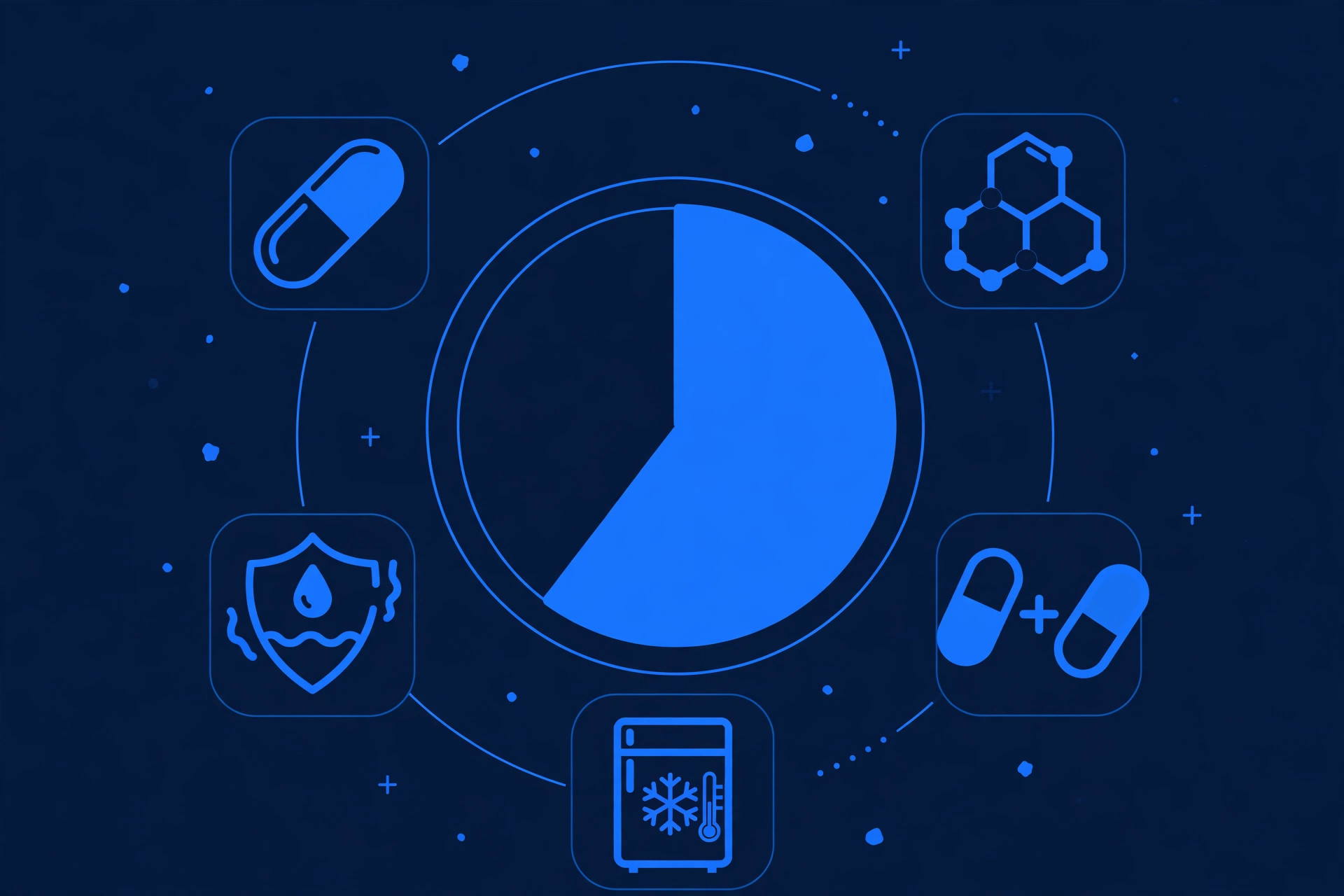
The PTCE Medications domain is 35% of the scored exam — about 28 of the 80 scored questions — covering brand and generic names, drug classes, interactions, side effects, and storage. Study it class-first: learn the name endings that reveal a drug's class, then the brand and generic pairs, then the interactions and storage rules the exam repeats.
What the Medications domain actually covers
The official outline breaks Medications into eight knowledge areas (PTCB PTCE Content Outline):
| Knowledge area | What it covers | What the question usually asks |
|---|---|---|
| 1.1 Generic names, brand names, and classifications | Brand/generic pairs and drug classes | Match the brand to the generic, or name the class |
| 1.2 Therapeutic duplications | Two drugs doing the same job | Spot the duplicate therapy on a patient profile |
| 1.3 Interactions and contraindications | Drug-drug, drug-disease, drug-nutrient, drug-supplement, and drug-laboratory interactions | Flag the combination the pharmacist needs to see |
| 1.4 Strengths, doses, dosage forms, routes, handling, and duration | How a drug is given and for how long | Pick the right strength, form, or route |
| 1.5 Side effects, adverse effects, and allergies | Common and severe reactions | Recognize the reaction that needs urgent attention |
| 1.6 Indications | What each drug is used to treat | Match the drug to its use |
| 1.7 Drug stability | How long a product stays good after opening or mixing | Work out a beyond-use date from the label |
| 1.8 Proper storage | Temperature ranges, light sensitivity, restricted access | Choose the right storage for the product |
That is the whole domain. If a study resource teaches something that fits none of those eight rows, it is not Medications material — no matter how confident the resource sounds.
For scale, the other domains are Patient Safety and Quality Assurance at 23.75% (about 19 scored questions), Order Entry and Processing at 22.5% (about 18), and Federal Requirements at 18.75% (about 15) (PTCB At-a-Glance: CPhT Exam). Medications alone is bigger than any other single domain, so give it the biggest share of your study time.
Learn drug classes by their endings
Generic drug names are not random. In the United States they are assigned by the United States Adopted Names (USAN) Council, which builds names from approved stems that signal a drug's class (Pillworks: Drug Name Stems and Suffixes). Learn the ending and you can classify a drug you have never seen before.
| Ending | Class | Examples |
|---|---|---|
| -pril | ACE inhibitors | lisinopril, enalapril, benazepril |
| -sartan | Angiotensin II receptor blockers (ARBs) | losartan, valsartan |
| -olol | Beta blockers | metoprolol, atenolol, propranolol |
| -dipine | Calcium channel blockers | amlodipine, nifedipine, felodipine |
| -statin | HMG-CoA reductase inhibitors (statins) | atorvastatin, simvastatin, rosuvastatin |
| -prazole | Proton pump inhibitors | omeprazole, pantoprazole, esomeprazole |
| -cillin | Penicillin antibiotics | amoxicillin, ampicillin |
| cef- / ceph- | Cephalosporin antibiotics | cephalexin, ceftriaxone, cefdinir |
| -floxacin | Fluoroquinolone antibiotics | levofloxacin, ciprofloxacin |
| -cycline | Tetracycline antibiotics | doxycycline, minocycline |
| -vir | Antivirals | acyclovir, valacyclovir, oseltamivir |
| -oxetine / -faxine | Antidepressants | fluoxetine, venlafaxine, duloxetine |
| -xaban | Factor Xa inhibitors (anticoagulants) | rivaroxaban, apixaban |
| -parin | Heparins (anticoagulants) | enoxaparin, heparin |
Sources: Pillworks: Drug Name Stems and Suffixes and Achievable: Generic names and brand names — PTCE Medications.
Stems are clues, not rules, and the exam knows the exceptions. Nystatin ends in -statin and is an antifungal, not a cholesterol drug. Tramadol ends in -dol, not -olol, and it is an opioid, not a beta blocker. And some real beta blockers break the pattern the other way: carvedilol, labetalol, and sotalol end in -lol without the "o" before it (Pillworks). Learn the pattern, then learn the exceptions by name.
The brand and generic pairs to learn first
The exam tests brand-to-generic matching constantly, drawing from the drugs pharmacies dispense every day. Learn these pairs before chasing rarer drugs (Achievable: Generic names and brand names — PTCE Medications; brand and generic names verified against FDA labels on DailyMed):
| Generic | Brand | Class |
|---|---|---|
| lisinopril | Prinivil, Zestril | ACE inhibitor |
| losartan | Cozaar | ARB |
| metoprolol | Lopressor, Toprol-XL | Beta blocker |
| amlodipine | Norvasc | Calcium channel blocker |
| atorvastatin | Lipitor | Statin |
| simvastatin | Zocor | Statin |
| omeprazole | Prilosec | Proton pump inhibitor |
| pantoprazole | Protonix | Proton pump inhibitor |
| levothyroxine | Synthroid | Thyroid hormone |
| metformin | Glucophage | Antidiabetic (biguanide) |
| albuterol | ProAir, Ventolin | Short-acting bronchodilator |
| amoxicillin | Amoxil | Penicillin antibiotic |
Learn each pair with its class and body system attached, not as a bare pair — the exam asks class-first questions, so class-first studying matches the test.
Interactions and contraindications the exam repeats
Knowledge area 1.3 is where the exam stops testing recall and starts testing judgment. The technician's job is not to decide what to do about an interaction — it is to spot it and get it to the pharmacist. These are the patterns that come up again and again, verified against FDA drug labels on DailyMed:
- Warfarin plus an NSAID (ibuprofen, naproxen). Both raise bleeding risk, and the combination is worse than either alone. A patient on warfarin picking up ibuprofen is a flag for the pharmacist, every time.
- ACE inhibitors plus potassium. ACE inhibitors raise potassium, so adding a potassium supplement or a potassium-sparing diuretic can push it too high.
- Tetracyclines plus calcium. Calcium, antacids, and dairy products bind tetracyclines like doxycycline and block their absorption — the doses have to be separated.
- Metformin plus iodinated contrast dye. Contrast procedures can affect kidney function, and metformin is held around them on a prescriber's instruction because of lactic acidosis risk. The technician's role is to know the hold exists, not to make the call.
- Some statins plus grapefruit juice. Grapefruit juice raises blood levels of some statins, simvastatin being the classic example.
- Duplicate therapy. Two drugs from the same class for the same problem — two ACE inhibitors, two proton pump inhibitors — is a therapeutic duplication (knowledge area 1.2), and it is the interaction-adjacent question the exam asks most. Scan every profile for two drugs doing the same job, and for the same ingredient hiding in two products, like acetaminophen in a pain reliever and a cold remedy.
Study interactions as pairs with a reason attached, not as a list of warnings — "warfarin + NSAID = bleeding" is a fact you can answer from.
High-alert medications and why the exam cares
High-alert medications are drugs that carry a heightened risk of causing significant patient harm when they are used in error. The Institute for Safe Medication Practices (ISMP) maintains the authoritative list, and its community and ambulatory care list names the categories the exam draws from (ISMP high-alert list):
- Antithrombotics — anticoagulants such as warfarin and heparin, and direct oral anticoagulants such as dabigatran, rivaroxaban, and apixaban
- Insulins, all formulations and strengths — including concentrated insulin U-500, which ISMP calls out with special emphasis
- Opioids, all routes — including liquid concentrates and immediate- and sustained-release formulations
- Chemotherapy agents, oral and parenteral
- Immunosuppressants — such as azathioprine, cyclosporine, and tacrolimus
- Specific high-alert drugs — including carbamazepine, lamotrigine, methotrexate, and epinephrine for injection
On the exam, a drug on this list signals extra safeguards: independent double checks, special storage, restricted access, and a pharmacist's verification before it goes out.
Stability and storage: the easy points
Knowledge areas 1.7 and 1.8 are the most predictable points in the domain, because the answers come straight from the label (MedlinePlus: Insulin and syringes — storage and safety; DailyMed):
- Insulin: unopened insulin stays refrigerated at 36–46°F (2–8°C) until its expiration date, and it must never be frozen. Most opened insulin is discarded 28 days after opening, whether kept at room temperature or in the refrigerator. Some products differ (insulin detemir lasts 42 days once opened), so the label is the final word, but 28 days is the default the exam expects.
- Refrigerated products: anything that must stay cold goes back in the refrigerator promptly, and freezing ruins it. If a product has been frozen, it is discarded, not thawed and used.
- Light-sensitive drugs: some products degrade in light and are dispensed in amber bottles or kept away from direct sunlight.
- Reconstituted suspensions: once a powder is mixed with water, the clock starts. Amoxicillin suspension, the classic example, is discarded 14 days after reconstitution when refrigerated, per its label — the exact limit always comes from the product's own label.
- Restricted access: controlled substances and high-alert drugs are stored with restricted access, and that storage rule is itself testable under knowledge area 1.8.
Bank these questions early: they have fixed right answers, and they reward candidates who read labels.
How to study this domain, in order
Work the domain the way the outline is built, not the way a random flashcard deck is shuffled:
- Learn the stems first. The table above covers most generic names you will meet. Drill it until an unfamiliar -pril or -sartan tells you the class on sight.
- Add the brand and generic pairs. Twenty to thirty pairs, learned with their class and body system, cover the matching questions.
- Study interactions as pairs with reasons. Warfarin plus NSAID, ACE inhibitor plus potassium, tetracycline plus calcium — each with the "why" attached.
- Memorize the high-alert list and the storage rules. These are short lists with fixed answers, and they are the cheapest points in the domain.
- Practice under exam pacing. You have 110 minutes for 90 questions, about 73 seconds per question (PTCB Guidebook). Medications questions should be your fastest answers: if you know the class from the stem, you answer and move on.
Give Medications about a third of your study time, matching its 35% weight — steady class-first study beats cramming 200 drug names the night before.
What not to study
The January 2026 outline removed material that old study resources still teach. Do not spend time on nonsterile compounding or narrow therapeutic index drugs as standalone topics, or on alligation calculations — all were removed effective January 6, 2026 (PTCB PTCE Content Outline). The retired 2020 domain weights (Medications 40%, Federal Requirements 12.5%, Patient Safety 26.25%, Order Entry 21.25%) are also still circulating; the current weights are 35%, 18.75%, 23.75%, and 22.5% (PTCB At-a-Glance: CPhT Exam). If a resource teaches the old weights, it is teaching the old exam.
What this guide can't do for you
Reading about drug classes is not the same as recognizing them under time pressure. The only way to find out whether the stems, the pairs, and the interaction patterns are actually sticking is to answer questions — and to see, for the ones you miss, exactly why the right answer is right.
Take the free 10-question PTCE diagnostic at upwardprep.com/ptce-practice-test/. It takes a few minutes, and every question comes with a cited explanation, so a miss becomes a study note instead of a mystery. Start there, then come back to this guide with your weak spots in hand.
Frequently asked questions
What medications should I study for the PTCE?
Study by drug class, not by a fixed list. The Medications domain covers brand and generic names, classifications, interactions, side effects, indications, and storage across the eight knowledge areas in the official outline (PTCB PTCE Content Outline). PTCB publishes no official Top 200 list, so learn the name stems, the common brand and generic pairs, and the interaction and storage rules in this guide.
How many questions on the PTCE are about medications?
Medications is 35% of the scored exam, about 28 of the 80 scored questions (PTCB PTCE Content Outline). PTCB publishes percentages, not per-domain question counts, so treat 28 as approximate. It is the largest single domain on the exam.
Does the PTCE test brand names or generic names?
Both. The outline's first Medications knowledge area is generic names, brand names, and classifications of medications (PTCB PTCE Content Outline), so expect questions that match a brand name to its generic, name the class a drug belongs to, or pick the generic when only the brand is given.
What are high-alert medications on the PTCE?
High-alert medications are drugs that carry a heightened risk of causing significant patient harm when used in error. The ISMP list includes antithrombotics, all insulins, all opioids, chemotherapy agents, and immunosuppressants, plus specific drugs such as methotrexate, carbamazepine, and lamotrigine (ISMP List of High-Alert Medications in Community/Ambulatory Care Settings). On the exam, a high-alert drug usually signals extra safeguards: double checks, special storage, and pharmacist verification.
How do I memorize drug classes for the PTCE?
Learn the USAN name stems first: the ending of a generic name usually tells you its class, so -pril means ACE inhibitor, -sartan means ARB, -olol means beta blocker, and -statin means statin (Pillworks: Drug Name Stems and Suffixes). Then learn the common brand and generic pairs with their class attached, and learn the exceptions — like nystatin, which ends in -statin but is an antifungal — by name.
What drug interactions should I know for the PTCE?
The highest-yield pairs are warfarin plus NSAIDs (bleeding risk), ACE inhibitors plus potassium (high potassium), tetracyclines plus calcium or antacids (blocked absorption), metformin around iodinated contrast procedures, and grapefruit juice with some statins — all verifiable on FDA labels via DailyMed. Also watch for therapeutic duplication: two drugs from the same class, or the same ingredient in two products, on one patient profile.